See them on the 3D body
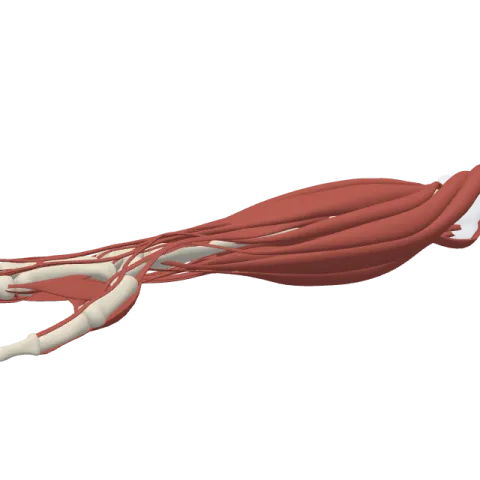
The metacarpal bones (1 to 5) lit on the 3D forearm and hand, as in the forearm and hand quiz. Turn the body, peel the layers, tap any structure for its name.
Quick answer
- Latin name
- Ossa metacarpi
- Type
- Long bones (five metacarpals)
- Location
- Palm of the hand, between the carpal bones and the proximal phalanges
- Joints
- Carpometacarpal joints with the carpal bones; intermetacarpal joints between the bases of metacarpals 2 to 5; metacarpophalangeal (knuckle) joints with the phalanges
The metacarpal bones are the five long bones of the palm. They run from the wrist to the base of each finger and are numbered 1 to 5 starting from the thumb. Their rounded heads are the knuckles you see when you make a fist.
Where they are and what they touch
The metacarpals sit between the distal row of carpal bones and the proximal phalanges. Muscles fill the spaces between them, and the long tendons of the forearm muscles cross them on the palm side and on the back.
Each metacarpal has the same three parts:
- The base, at the wrist end, is wide and has flat facets for the carpal bones and for the neighboring metacarpals.
- The shaft is slightly curved, hollow on the palm side, which helps shape the palm into a cup.
- The head, at the finger end, is rounded and covered with cartilage. It fits into the base of a proximal phalanx.
For the whole hand, with the carpals and the phalanges, see bones of the hand.
The metacarpals one by one
First metacarpal (thumb)
The first metacarpal is the shortest and thickest. It does not lie in line with the other four: it is turned about a quarter turn, so the thumb faces across the palm. Its base has a saddle-shaped surface that meets the trapezium. This saddle joint is what lets the thumb swing across the palm and touch the tips of the other fingers, the movement called opposition. Its base does not join the second metacarpal, which leaves it free to move.
Second metacarpal (index finger)
The second metacarpal is usually the longest. Its base is notched and sits between the trapezium, the trapezoid and the capitate, which locks it in place. Two wrist muscles, the flexor carpi radialis and the extensor carpi radialis longus, insert on its base.
Third metacarpal (middle finger)
The third metacarpal meets the capitate. A small spike juts up from the back of its base, the styloid process, where the extensor carpi radialis brevis inserts.
Fourth metacarpal (ring finger)
The fourth metacarpal is thinner and shorter than the third. Its base meets the hamate and part of the capitate.
Fifth metacarpal (little finger)
The fifth metacarpal meets the hamate. A tubercle on the inner side of its base receives the extensor carpi ulnaris. A fracture of the neck of this bone, just behind the knuckle, is often called a boxer's fracture.
Joints
- Carpometacarpal joints. The joints of the second and third metacarpals barely move: they form the rigid center of the hand. The fourth and fifth move a little more, which lets you cup the palm. The joint of the thumb is a saddle joint and moves the most of all.
- Intermetacarpal joints. Small joints between the bases of metacarpals 2 to 5.
- Metacarpophalangeal joints. The knuckle joints, between each metacarpal head and its proximal phalanx. They let the fingers bend, straighten, spread apart and come together. Ligaments tie the heads of metacarpals 2 to 5 to each other, but not the thumb.
Muscles attached
Wrist muscles insert on the bases, and the small muscles of the hand start on the shafts:
- Flexor carpi radialis inserts on the bases of the second and third metacarpals and flexes the wrist.
- Extensor carpi radialis longus inserts on the back of the second base and extensor carpi radialis brevis on the third. Both extend the wrist.
- Extensor carpi ulnaris inserts on the base of the fifth metacarpal. The flexor carpi ulnaris reaches the same bone through a ligament from the pisiform.
- Abductor pollicis longus inserts on the base of the first metacarpal and moves the thumb away from the palm.
- Opponens pollicis and opponens digiti minimi insert along the first and fifth shafts and pull them toward each other.
- Adductor pollicis has a transverse head that starts on the shaft of the third metacarpal and an oblique head that starts on the capitate and the bases of the second and third.
- The dorsal interossei start from the facing sides of neighboring metacarpals, and the palmar interossei from single metacarpals. They spread and close the fingers.
How to remember them
- Count from the thumb. Metacarpal 1 is the thumb, 5 is the little finger, just as for the fingers.
- Fist test. Make a fist: each knuckle is a metacarpal head. The thumb knuckle sits apart, which shows how the first metacarpal points away.
- Two and three stay still. The index and middle metacarpals are locked to the wrist, and the wrist extensors pull on them like on a fixed post.
- "Meta" means beyond. The metacarpals lie beyond the carpus, the wrist.
In Anatomy Atlas 3D
Each metacarpal has its own name in the app, from "First metacarpal bone" to "Fifth metacarpal bone". Tap them one by one, then turn the hand to see the twist of the first metacarpal. Test yourself in the forearm and hand quiz. The app is free on iPad and iPhone.
Frequently asked questions
How many metacarpal bones are in one hand?
Five, one for each digit, numbered from the thumb (1) to the little finger (5).
Which metacarpal is the longest?
The second, for the index finger. The first, for the thumb, is the shortest and thickest.
What are the knuckles made of?
The heads of the metacarpals. Each meets the base of a proximal phalanx at a metacarpophalangeal joint.
Why does the thumb move so much more than the fingers?
Its metacarpal meets the trapezium at a saddle joint and is not tied to the second metacarpal, so it can swing across the palm.
Muscles that originate here
From the anatomical data behind Anatomy Atlas 3D (Z-Anatomy, reviewed). In the app, tap the bone, then each muscle around it to open its card.
