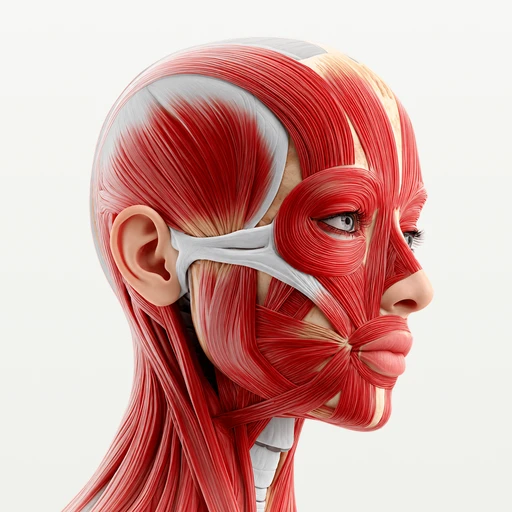
See them on the 3D body
The cervical vertebrae (C3 to C7) lit on the 3D back, as in the back quiz. Turn the body, peel the layers, tap any structure for its name.
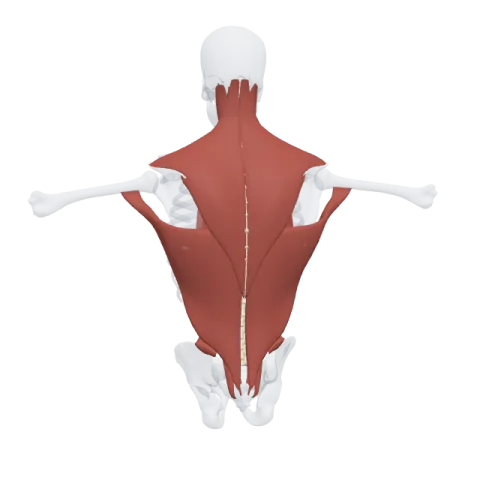
Quick answer
- Latin name
- Vertebrae cervicales
- Type
- Irregular bones (five typical cervical vertebrae, C7 slightly atypical)
- Location
- Neck, between the axis (C2) above and the first thoracic vertebra (T1) below
The cervical vertebrae C3 to C7 are the five lower bones of the neck, stacked between the axis (C2) and the first thoracic vertebra. They are small, light and very mobile, and every one of them has a hole in each transverse process for the vertebral artery and veins, the feature that marks a vertebra as cervical.
Where they are and what they touch
The neck has seven cervical vertebrae. The first two, the atlas and the axis, are so unusual that they have their own pages. C3 to C6 share the same typical shape, and C7, at the base of the neck, is a transition toward the thoracic spine.
Together they form the cervical curve, which is convex toward the front. The vertebrae carry the head, protect the spinal cord inside the vertebral canal, and let the neck nod, tilt and turn. Each one joins the vertebra above and below at three points: one disc in front and two small facet joints behind. The full column is described on the bones of the spine page.
Features of a typical cervical vertebra (C3 to C6)
Body
The body is small and wider from side to side than from front to back, because the neck carries only the weight of the head. The upper surface has a raised lip on each side, the uncinate process. Each lip meets a bevel on the body above and forms a small uncovertebral joint, which guides movement and keeps the discs from slipping sideways.
Vertebral foramen
The vertebral foramen is large and triangular. The spinal cord is thick in the neck, where the nerves to the upper limbs leave it, so it needs room.
Transverse processes
Each transverse process is pierced by a transverse foramen. From C6 up to C1, the vertebral artery climbs through these holes on its way to the brain. Each process ends in two small bumps, an anterior tubercle and a posterior tubercle, with a groove between them where the spinal nerve runs out. The anterior tubercle of C6 is large and is called the carotid tubercle, because the common carotid artery lies just in front of it.
Articular processes
The superior and inferior articular processes form a column of bone on each side, the articular pillar. Their flat facets face up and back, or down and forward, at a slant. This tilt allows bending forward and back, side bending and rotation, so the neck is the most mobile part of the spine.
Spinous process
The spinous process is short and usually bifid: split into two small points at its tip. C6 is the last level where this is common.
C7, the vertebra prominens
C7 has the longest spinous process of the neck, and it is not split. It ends in a single knob that you can feel at the base of the back of the neck, especially when you bend your head forward. This is why C7 is called the vertebra prominens.
C7 also has smaller transverse foramina. The vertebral artery usually does not pass through them: it enters the column at C6. Only small veins use the C7 holes. Its body and lower facets start to look like those of T1, which it joins below.
Joints and nerves
- Intervertebral discs join the bodies. They are fibrocartilage pads with a soft center, and they absorb shock.
- Facet (zygapophyseal) joints are small synovial joints between the articular processes. They set the direction of movement.
- Uncovertebral joints sit at the side edges of the bodies, from C3 down.
There are seven cervical vertebrae but eight cervical spinal nerves. Each cervical nerve leaves above the vertebra with the same number, so the C8 nerve exits between C7 and T1. From T1 down, each nerve leaves below its vertebra.
Muscles attached
The neck vertebrae anchor many small muscles that move the head and neck, plus a few that reach the shoulder:
- Levator scapulae starts on the transverse processes of the upper cervical vertebrae, including C3 and C4, and pulls the scapula up.
- The three scalene muscles start on the tubercles of the transverse processes and run down to the first and second ribs. They tilt the neck and raise the ribs in deep breathing.
- Rhomboid minor starts on the spinous processes of C7 and T1, just above the rhomboid major.
- The trapezius reaches the neck through the nuchal ligament, a strong band running from the skull to the spine of C7.
- Deep muscles such as the splenius, the semispinalis and the longus colli attach along the spines, transverse processes and bodies.
How to remember them
- Holes mean neck. If a vertebra has a transverse foramen, it is cervical. No other region has them.
- Split tips, C3 to C6. Bifid spines belong to the middle of the neck. The single, long tip is C7.
- Feel C7. Bend your head forward and run a finger down the back of your neck: the first big bump is C7, and the one just below is often T1. Counting from here is how you find other levels.
- Six for the carotid. The carotid tubercle is on C6, and C6 is also where the vertebral artery goes in.
In Anatomy Atlas 3D
In the app each cervical vertebra is a separate structure, named "Vertebra C3" to "Vertebra C7". Tap one to see its name, then hide the muscles to look at the transverse foramina from the side. Test yourself in the back quiz. Anatomy Atlas 3D is free on iPad and iPhone.
Frequently asked questions
Why is C7 called the vertebra prominens?
Its long spinous process sticks out at the base of the neck and is easy to see and feel. It is the most visible bump of the neck spine.
What passes through the transverse foramina of the cervical vertebrae?
The vertebral artery and vein. The artery usually enters at C6 and climbs through C5 to C1. The foramina of C7 carry only small veins.
What are the uncinate processes?
Raised lips on the side edges of the upper surface of the bodies of C3 to C7. They form uncovertebral joints with the vertebra above.
How many cervical spinal nerves are there?
Eight, for seven vertebrae. The C8 nerve leaves between C7 and T1.
Muscles that originate here
From the anatomical data behind Anatomy Atlas 3D (Z-Anatomy, reviewed). In the app, tap the bone, then each muscle around it to open its card.
