
See them on the 3D body
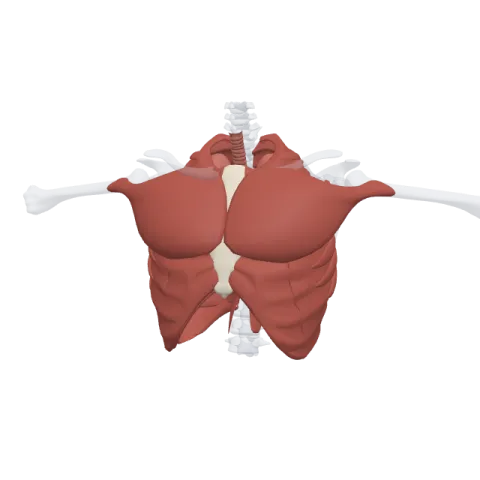
The ribs (1 to 12) lit on the 3D thorax, as in the thorax quiz. Turn the body, peel the layers, tap any structure for its name.
Quick answer
- Latin name
- Costae
- Type
- Flat bones (twelve pairs of ribs)
- Location
- Walls of the chest, from the thoracic vertebrae behind to the sternum and costal cartilages in front
- Joints
- Costovertebral and costotransverse joints with the thoracic vertebrae; costochondral joints with the costal cartilages; sternocostal joints, through the cartilages, with the sternum (ribs 1 to 7)
The ribs are twelve pairs of curved, flat bones that form the walls of the chest. Each one starts at a thoracic vertebra in the back and curves around the side of the body. Ribs 1 to 7 are true ribs, ribs 8 to 12 are false ribs, and the last two, ribs 11 and 12, are also called floating ribs.
Where they are and what they touch
Behind, every rib joins the thoracic vertebrae. In front, most ribs continue as a bar of hyaline cartilage, the costal cartilage. The way these cartilages reach the sternum sorts the ribs into three groups:
- True ribs (1 to 7): each has its own cartilage that joins the sternum directly.
- False ribs (8 to 10): their cartilages join the cartilage of the rib above instead of the sternum. With the cartilage of rib 7, they form the costal margin, the lower edge of the rib cage you can feel below the chest.
- Floating ribs (11 and 12): short ribs with a small cap of cartilage that ends in the muscles of the side and back wall. They have no front attachment. They are still counted among the false ribs.
The ribs get longer from rib 1 to rib 7, then shorter again down to rib 12. The spaces between them, the intercostal spaces, are filled by the intercostal muscles. The whole cage, with the sternum, is covered on the bones of the rib cage page.
Parts of a typical rib (ribs 3 to 9)
- The head at the back end has two facets, separated by a ridge, the crest. The facets sit against the bodies of two vertebrae: the vertebra with the same number and the one above.
- The neck is the short, narrow part after the head.
- The tubercle is a bump where the neck meets the shaft. Its joint surface rests on the transverse process of the vertebra with the same number.
- The angle is the point where the shaft bends sharply forward, a little way out from the tubercle.
- The shaft, or body, is thin, flat and curved, and also twisted along its length.
- The costal groove runs along the lower inner edge of the shaft. It shelters the intercostal vein, artery and nerve, in that order from top to bottom.
The first rib
The first rib is the broadest and most curved rib, and usually the shortest. It lies almost flat, with an upper and a lower surface, under the clavicle at the base of the neck.
- Its head has a single facet, because it meets only T1.
- On the inner edge of its upper surface is the scalene tubercle, where the scalenus anterior attaches.
- In front of this tubercle runs a shallow groove for the subclavian vein. Behind it runs a groove for the subclavian artery and the lowest part of the brachial plexus, on their way to the upper limb.
- The scalenus medius attaches farther back on the upper surface.
The second rib
The second rib is thinner and about twice as long as the first. Its outer surface has a rough area, the tuberosity for serratus anterior. Its cartilage meets the sternum at the sternal angle, the ridge between the manubrium and the body of the sternum. You can feel this ridge, so it is the usual starting point for counting ribs.
Ribs 10, 11 and 12
- Rib 10 has a single facet on its head, as it meets only T10.
- Ribs 11 and 12 have a single facet, no neck and no tubercle, so they do not touch the transverse processes. Their front ends are pointed and tipped with cartilage.
- Rib 12 is the shortest of the lower ribs. The diaphragm and the quadratus lumborum attach to it.
Joints
- Costovertebral joints: the head of each rib against the vertebral bodies.
- Costotransverse joints: the tubercle of ribs 1 to 10 against the transverse process.
- Costochondral joints: where each rib ends and its cartilage begins.
- Sternocostal joints: the cartilages of ribs 1 to 7 against the sternum. The first one is a fixed cartilage joint; the others are small synovial joints.
When you breathe in, the ribs rotate at their back joints and their front ends rise, which makes the chest wider and deeper.
Muscles attached
- The external, internal and innermost intercostals fill each intercostal space and move the ribs during breathing.
- The diaphragm attaches to the inner surfaces of the lower six costal cartilages and ribs.
- The serratus anterior starts on the outer surfaces of the upper eight or nine ribs.
- The pectoralis minor starts on ribs 3 to 5, and the pectoralis major on the upper costal cartilages.
- The scalenes insert on ribs 1 and 2.
- The external oblique starts on the outer surfaces of the lower eight ribs, the internal oblique attaches to the lower edges of ribs 10 to 12, and the rectus abdominis inserts on cartilages 5 to 7.
How to remember them
- 7, 3, 2. Seven true, three false, two floating: twelve pairs in total.
- The sternal angle is rib 2. Find the ridge on the sternum, slide sideways, and you are on rib 2. Count down from there.
- VAN in the groove. Vein, artery, nerve, from top to bottom in the costal groove.
- One facet ribs. Ribs 1, 10, 11 and 12 touch only one vertebra each.
In Anatomy Atlas 3D
The app names each rib separately, from "First rib" to "Twelfth rib". Tap a rib, then hide the muscles to follow it from the spine to the sternum. Try the thorax quiz to check that you can tell them apart. Anatomy Atlas 3D is free on iPad and iPhone.
Frequently asked questions
How many ribs do humans have?
Twelve pairs, so 24 ribs, in both males and females. An extra rib in the neck or lower back is an occasional variation.
Which ribs are true, false and floating?
Ribs 1 to 7 are true ribs. Ribs 8 to 12 are false ribs. Among the false ribs, 11 and 12 are floating ribs.
Why are floating ribs called floating?
They have no attachment to the sternum or to other cartilages in front. Their tips end in the muscles of the abdominal wall.
What is special about the first rib?
It is broad, flat and strongly curved, meets only T1, carries the scalene tubercle and has grooves for the subclavian vessels.
Muscles that originate here
Muscles that insert here
From the anatomical data behind Anatomy Atlas 3D (Z-Anatomy, reviewed). In the app, tap the bone, then each muscle around it to open its card.
