
Muscle · Upper limb
Extensor indicis: origin, insertion, action and innervation
The extensor indicis runs from the lower ulna to the index finger. It extends the index finger on its own and is supplied by the posterior interosseous nerve.
Quick answer
- Latin name
- Musculus extensor indicis
- Origin
- Posterior surface of the lower part of the ulna and the nearby interosseous membrane
- Insertion
- Extensor expansion of the index finger, joining the extensor digitorum tendon to that finger on its ulnar side
- Action
- Extends the index finger independently of the other fingers; helps extend the wrist
- Innervation
- Posterior interosseous nerve, from the deep branch of the radial nerve (C7-C8)
- Blood supply
- Posterior interosseous artery
See it on the 3D body
The extensor indicis lit on the 3D forearm and hand, as in the forearm and hand quiz. Turn the body, peel the layers, tap any structure for its name.
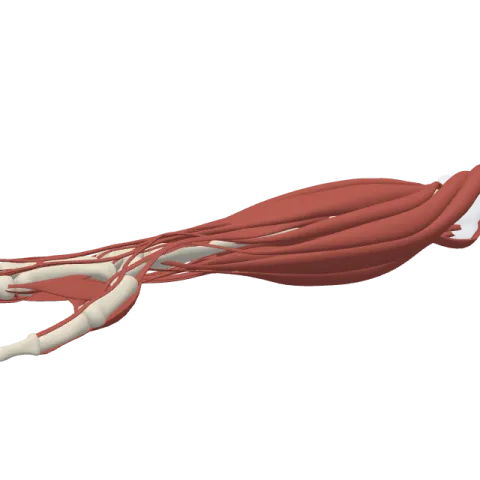
The extensor indicis is a small, deep muscle on the back of the forearm that gives the index finger its own extensor. It runs from the lower ulna to the back of the index finger, lets you point while the other fingers stay curled, and is supplied by the posterior interosseous nerve.
Where it is
The extensor indicis is the lowest muscle of the deep layer of the posterior compartment. It lies close to the wrist, on the back of the lower ulna, just below and beside the extensor pollicis longus. The superficial extensors cover it completely, so you cannot see or feel its belly through the skin.
Indicis means "of the index", the pointing finger (from the Latin indicare, to point out). Older books call it the extensor indicis proprius, "the index finger's own extensor".
Its tendon passes under the extensor retinaculum in the fourth extensor compartment, together with the four tendons of the extensor digitorum. On the back of the hand it runs beside the extensor digitorum tendon to the index finger, on the side closer to the middle finger. The two tendons then merge into one extensor expansion.
Origin and insertion
- Origin: the back of the lower third of the ulna and the nearby interosseous membrane, the fibrous sheet between the radius and the ulna.
- Insertion: the extensor expansion of the index finger, which it joins on the ulnar side of the extensor digitorum tendon. Through the expansion, its pull reaches the middle and distal phalanges.
The phalanges of the hand page shows the bones of the index finger that the expansion covers.
What it does
- Independent extension of the index finger: it straightens the index finger, mainly at the knuckle (metacarpophalangeal joint), even when the middle, ring and little fingers stay bent. The extensor digitorum moves all four fingers together; the extensor indicis adds the freedom to move one.
- Help with wrist extension: because its tendon crosses the back of the wrist, it adds a little force when the wrist bends back.
This is the muscle behind pointing at a map, pressing a single key or giving directions. The little finger has a similar private extensor, the extensor digiti minimi. The middle and ring fingers have none, which is part of the reason they are harder to lift on their own.
Innervation and blood supply
The extensor indicis is supplied by the posterior interosseous nerve (roots C7 and C8). By the time the nerve reaches this muscle, near the wrist, it has already supplied the rest of the deep layer. It is often listed as the last muscle that the posterior interosseous nerve supplies.
Its blood comes from the posterior interosseous artery, which runs down the back of the forearm with the nerve.
How to remember it
- Indicis indicates: the muscle that lets the index finger point.
- Two fingers with a private extensor: the index (extensor indicis) and the little finger (extensor digiti minimi). Point, or make a "rock on" sign: both use them.
- Lowest on the ulna: of the four deep extensors, the extensor indicis starts closest to the wrist.
- Fourth tunnel, five tendons: the fourth extensor compartment carries the four extensor digitorum tendons plus the extensor indicis.
Test yourself in the forearm and hand quiz, and see where the deep extensors sit on the muscles of the forearm page.
Frequently asked questions
What does the extensor indicis do?
It extends the index finger independently of the other fingers and helps extend the wrist.
Where does the extensor indicis originate?
From the posterior surface of the lower third of the ulna and the interosseous membrane.
Which nerve supplies the extensor indicis?
The posterior interosseous nerve, the deep branch of the radial nerve, from roots C7 and C8.
Why can I point with my index finger but not lift my ring finger alone?
Because the index finger has its own extensor muscle, the extensor indicis. The ring finger depends on the shared extensor digitorum, whose tendons are linked together on the back of the hand.
