Muscle · Upper limb
Extensor pollicis longus: origin, insertion, action and innervation
The extensor pollicis longus runs from the ulna to the thumb's distal phalanx. It extends the whole thumb and is supplied by the posterior interosseous nerve.
Quick answer
- Latin name
- Musculus extensor pollicis longus
- Origin
- Posterior surface of the middle third of the ulna and the interosseous membrane
- Insertion
- Back of the base of the distal phalanx of the thumb
- Action
- Extends the thumb at the interphalangeal joint, and also at the metacarpophalangeal and carpometacarpal joints
- Innervation
- Posterior interosseous nerve, from the deep branch of the radial nerve (C7-C8)
- Blood supply
- Posterior interosseous artery
See it on the 3D body
The extensor pollicis longus lit on the 3D forearm and hand, as in the forearm and hand quiz. Turn the body, peel the layers, tap any structure for its name.
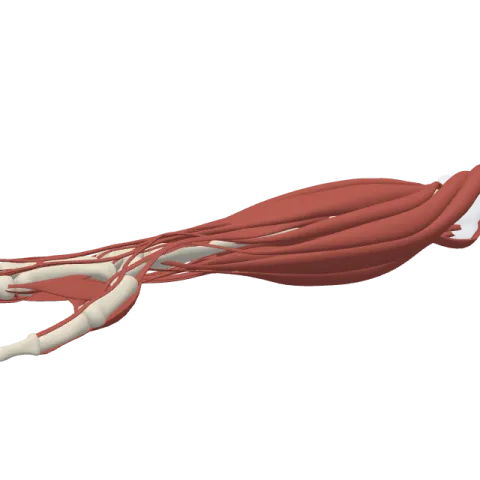
The extensor pollicis longus is the deep forearm muscle that straightens the whole thumb, down to its tip. It runs from the middle of the ulna to the base of the distal phalanx of the thumb, using a bump on the radius as a pulley, and it is supplied by the posterior interosseous nerve.
Where it is
The extensor pollicis longus (EPL) belongs to the deep layer of the posterior compartment. Its belly lies on the back of the middle ulna, between the extensor pollicis brevis on the thumb side and the extensor indicis below it.
Its tendon takes an unusual route. At the wrist it passes alone through the third extensor compartment and hooks around the dorsal tubercle of the radius (Lister's tubercle), a small bony ridge you can feel on the back of the lower radius. The tubercle works like a pulley: the tendon arrives from the ulna side and leaves at an angle toward the thumb, crossing over the tendons of the two radial wrist extensors.
On the thumb, the EPL tendon forms the back border of the anatomical snuffbox. Stretch your thumb back hard and the hollow at its base appears, with the EPL as the sharp cord on the side closer to the back of the hand.
Origin and insertion
- Origin: the posterior surface of the middle third of the ulna and the nearby interosseous membrane.
- Insertion: the back of the base of the distal phalanx of the thumb, the bone that carries the thumbnail.
Because it reaches the last bone of the thumb, it crosses every joint of the thumb ray: the carpometacarpal joint at the base, the metacarpophalangeal joint (the knuckle) and the interphalangeal joint near the tip. The phalanges of the hand page shows the two thumb phalanges.
What it does
- Extension of the thumb tip: it is the main muscle that straightens the interphalangeal joint of the thumb.
- Extension of the rest of the thumb: it also extends the knuckle and the carpometacarpal joint, working with the extensor pollicis brevis and the abductor pollicis longus.
- Pulling the thumb back alongside the hand: because of the angle around the dorsal tubercle, it draws the extended thumb back toward the index finger and lifts it behind the plane of the palm.
A simple test: lay the hand flat on a table, palm down, and lift only the thumb off the surface. The EPL does this move, and its tendon jumps out at the snuffbox.
Innervation and blood supply
The EPL is supplied by the posterior interosseous nerve (roots C7 and C8), the continuation of the deep branch of the radial nerve on the back of the forearm.
Its blood comes from the posterior interosseous artery.
The EPL tendon can rupture some weeks after a fracture of the lower end of the radius, where it rubs over the dorsal tubercle.
How to remember it
- Longus goes the longest: it is the only thumb extensor that reaches the distal phalanx.
- Lister's tubercle is the pulley: the EPL is the tendon that changes direction around it.
- Lift the thumb off the table: with the palm flat, this movement isolates the EPL.
- Starts on the ulna, ends on the thumb: the EPL begins on the little-finger side of the forearm, so its tendon has to cross the back of the wrist diagonally to reach the thumb.
Test yourself in the forearm and hand quiz, and see the order of the deep extensors on the muscles of the forearm page.
Frequently asked questions
What does the extensor pollicis longus do?
It extends the thumb at the interphalangeal joint and also at the metacarpophalangeal and carpometacarpal joints.
Where does the extensor pollicis longus insert?
On the back of the base of the distal phalanx of the thumb.
Which nerve supplies the extensor pollicis longus?
The posterior interosseous nerve, the deep branch of the radial nerve, from roots C7 and C8.
Which tendon forms the back border of the anatomical snuffbox?
The extensor pollicis longus. The abductor pollicis longus and the extensor pollicis brevis form the other border.
What is Lister's tubercle?
It is the dorsal tubercle of the radius, a small ridge on the back of the lower radius. The EPL tendon bends around it on its way to the thumb.
