
Muscle · Upper limb
Extensor pollicis brevis: origin, insertion, action and innervation
The extensor pollicis brevis runs from the radius to the thumb's proximal phalanx. It extends the thumb and is supplied by the posterior interosseous nerve.
Quick answer
- Latin name
- Musculus extensor pollicis brevis
- Origin
- Posterior surface of the radius, below the abductor pollicis longus, and the interosseous membrane
- Insertion
- Back of the base of the proximal phalanx of the thumb
- Action
- Extends the thumb at the metacarpophalangeal joint; helps extend it at the carpometacarpal joint
- Innervation
- Posterior interosseous nerve, from the deep branch of the radial nerve (C7-C8)
- Blood supply
- Posterior interosseous artery
See it on the 3D body
The extensor pollicis brevis lit on the 3D forearm and hand, as in the forearm and hand quiz. Turn the body, peel the layers, tap any structure for its name.
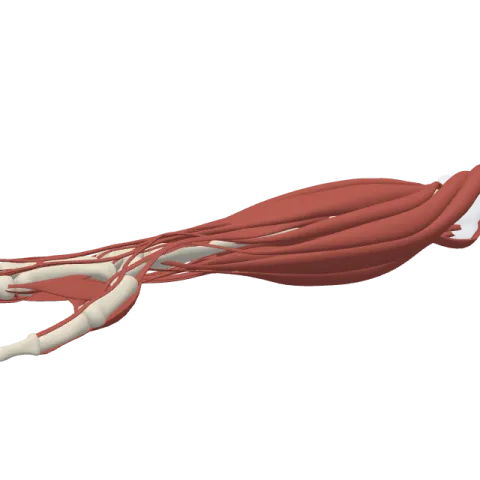
The extensor pollicis brevis is a deep forearm muscle that straightens the thumb at its knuckle, the metacarpophalangeal joint. It runs from the back of the radius to the base of the thumb's first phalanx and is supplied by the posterior interosseous nerve.
Where it is
The extensor pollicis brevis (EPB) lies in the deep layer of the posterior compartment, on the back of the radius. It starts just below the abductor pollicis longus and stays beside it for the whole route: the two muscles surface together between the wrist extensors in the lower forearm, cross over the radial wrist extensor tendons and head for the thumb.
Pollicis means "of the thumb", and brevis means "short". It is the short extensor of the thumb, compared with the extensor pollicis longus, whose tendon goes all the way to the tip.
At the wrist, the EPB tendon shares the first extensor compartment with the APL tendon, over the outer side of the lower radius. Just beyond, the pair forms the palm-side border of the anatomical snuffbox, the hollow at the base of the thumb that appears when you stretch the thumb back. The EPB tendon is the one closer to the back of the hand, and you can usually see it as a thin cord.
Origin and insertion
- Origin: the posterior surface of the radius, below the origin of the abductor pollicis longus, and the nearby interosseous membrane.
- Insertion: the back of the base of the proximal phalanx of the thumb.
That is the key fact for exams. The EPB stops at the first phalanx, so it cannot reach the joint near the tip of the thumb. The phalanges of the hand page shows the two phalanges of the thumb.
What it does
- Extension at the metacarpophalangeal joint: it straightens the thumb at its knuckle, the joint between the first metacarpal and the proximal phalanx.
- Help at the carpometacarpal joint: because its tendon also crosses the base of the thumb, it helps pull the first metacarpal back and out, assisting the APL.
- No action on the thumb tip: bending or straightening the last joint of the thumb is the job of the flexor pollicis longus and the extensor pollicis longus.
Try this: keep the tip of your thumb bent and lift the rest of the thumb back. The movement at the knuckle comes partly from the EPB, and the cord at the snuffbox stands out as you do it.
Innervation and blood supply
The EPB is supplied by the posterior interosseous nerve (roots C7 and C8), the deep branch of the radial nerve after it has crossed the supinator. Every muscle of the deep posterior layer shares this nerve.
Its blood comes from the posterior interosseous artery.
Because it shares a sheath with the APL in the first extensor compartment, the EPB tendon is involved in De Quervain tenosynovitis, an irritation of that sheath.
How to remember it
- Brevis stops short: the short extensor ends on the first phalanx; the long one runs to the last.
- Snuffbox: two in front, one behind: APL and EPB on the palm side, EPL on the back side.
- Brevis rides with the abductor: neighboring origins, same compartment, same border of the snuffbox.
- One phalanx, one joint: the EPB acts mainly on the single joint just before its insertion, the knuckle.
Test yourself in the forearm and hand quiz, and see the deep layer of the back of the forearm on the muscles of the forearm page.
Frequently asked questions
What does the extensor pollicis brevis do?
It extends the thumb at the metacarpophalangeal joint and helps extend it at the carpometacarpal joint.
Where does the extensor pollicis brevis insert?
On the back of the base of the proximal phalanx of the thumb.
Which nerve supplies the extensor pollicis brevis?
The posterior interosseous nerve, from roots C7 and C8.
What is the difference between the extensor pollicis brevis and longus?
The brevis starts on the radius and inserts on the proximal phalanx, so it extends the thumb knuckle. The longus starts on the ulna and inserts on the distal phalanx, so it also extends the tip of the thumb.
Is the extensor pollicis brevis part of the anatomical snuffbox?
Yes. With the abductor pollicis longus, its tendon forms the palm-side border of the snuffbox.
