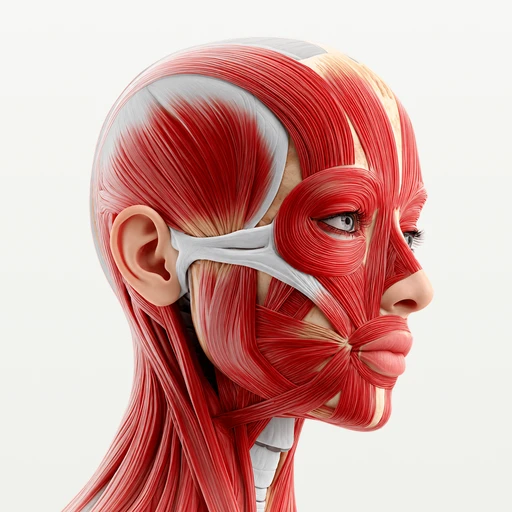
Muscle · Head and neck
Platysma: origin, insertion, action and innervation
The platysma runs from the upper chest to the mandible and lower face. It tenses the neck skin and is supplied by the cervical branch of the facial nerve.
Quick answer
- Latin name
- Platysma
- Origin
- Skin and fascia over the upper chest, covering the upper parts of the pectoralis major and deltoid
- Insertion
- Lower border of the mandible, skin of the lower face and the corner of the mouth, blending with the lip depressors
- Action
- Tenses the skin of the neck, raising vertical ridges; pulls the corners of the mouth down; weakly helps depress the mandible
- Innervation
- Cervical branch of the facial nerve (CN VII)
- Blood supply
- Submental branch of the facial artery and the suprascapular artery
See it on the 3D body
The platysma lit on the 3D neck, as in the neck quiz. Turn the body, peel the layers, tap any structure for its name.
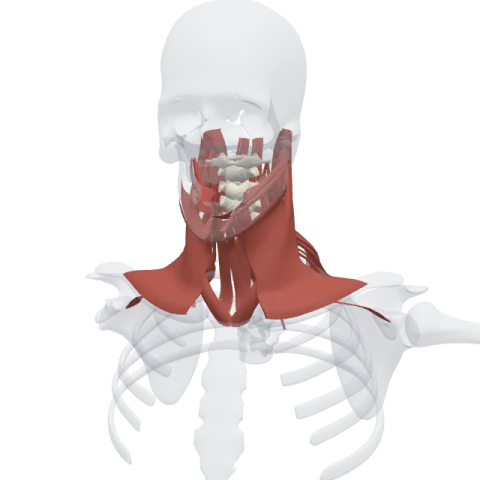
The platysma is a broad, very thin sheet of muscle that lies just under the skin of the neck, from the upper chest to the jaw. When it contracts it tightens the neck skin into vertical ridges and pulls the corners of the mouth down, and it is supplied by the facial nerve.
Where it is
The platysma covers most of the front and side of the neck on each side. It lies in the superficial fascia, directly under the skin, above every other neck muscle. Below it you find the external jugular vein, the sternocleidomastoid and the strap muscles.
The left and right sheets are close together near the chin, where their front fibers often cross the midline, and spread apart lower down. This leaves a gap in the middle of the lower neck where no platysma covers the strap muscles.
Although it sits in the neck, the platysma counts as a muscle of facial expression. Like the other facial muscles, it attaches to skin rather than moving a joint, it develops from the second pharyngeal arch, and it is supplied by the facial nerve. The muscles of the face page covers the rest of that group.
Origin and insertion
- Origin: the skin and fascia of the upper chest, over the top of the pectoralis major and the front of the deltoid, below the clavicle.
- Insertion: the lower border of the mandible, the skin of the lower face and cheek, and the corner of the mouth, where it blends with the muscles that pull the lower lip and the mouth corner down.
Its fibers run upward and slightly inward, crossing over the clavicle and the jawline.
What it does
- Tenses the skin of the neck: it pulls the neck skin up from the chest, raising vertical ridges and folds. You see this when someone clenches their teeth and grimaces, or when someone stretches the skin under the jaw to shave it.
- Pulls the mouth down: through its attachments near the lips, it draws the corners of the mouth down and out, as in an expression of strain, fear or disgust.
- Helps open the jaw: it gives weak help in pulling the mandible down, especially against resistance.
Innervation and blood supply
The platysma is supplied by the cervical branch of the facial nerve (CN VII). This branch leaves the facial nerve inside the parotid gland, comes out of its lower end near the angle of the mandible and runs down onto the deep surface of the muscle.
Blood comes from the submental branch of the facial artery in the upper part and from the suprascapular artery in the lower part, with small contributions from nearby vessels.
How to remember it
- Platys means flat: from the Greek for "broad, flat". It is a wide, thin sheet rather than a rounded belly.
- A facial muscle that slipped down: it behaves like the face muscles (skin attachment, nerve VII) even though it lives on the neck.
- Grimace test: clench your teeth and pull the corners of your mouth down hard. The cords that stand out on your neck are the platysma.
- Facial nerve, lowest branch: temporal, zygomatic, buccal, marginal mandibular, cervical. The platysma takes the last one.
Test yourself in the neck quiz.
Frequently asked questions
What does the platysma muscle do?
It tenses the skin of the neck into vertical ridges, pulls the corners of the mouth down and weakly helps depress the mandible.
What nerve supplies the platysma?
The cervical branch of the facial nerve (CN VII).
Is the platysma a muscle of facial expression?
Yes. It lies in the neck, but it attaches to skin, comes from the second pharyngeal arch and is supplied by the facial nerve, like the other facial muscles.
Where is the platysma?
Directly under the skin of the front and side of the neck, from the upper chest to the lower border of the mandible.
