Muscle · Trunk
Quadratus lumborum: origin, insertion, action and innervation
The quadratus lumborum runs from the iliac crest to the 12th rib and L1-L4. It bends the lumbar spine sideways and is supplied by T12-L4 anterior rami.
Quick answer
- Latin name
- Musculus quadratus lumborum
- Origin
- Back part of the iliac crest of the hip bone and the iliolumbar ligament
- Insertion
- Medial half of the lower border of the twelfth rib and the tips of the transverse processes of L1–L4 (lumbar vertebrae)
- Action
- One side: bends the lumbar spine laterally and can hitch the hip up. Both sides: steady the twelfth rib in breathing and help extend the lumbar spine
- Innervation
- Anterior rami of T12–L4 (subcostal nerve and lumbar nerves)
- Blood supply
- Lumbar arteries, the subcostal artery and the lumbar branch of the iliolumbar artery
See it on the 3D body
The quadratus lumborum lit on the 3D back, as in the back quiz. Turn the body, peel the layers, tap any structure for its name.
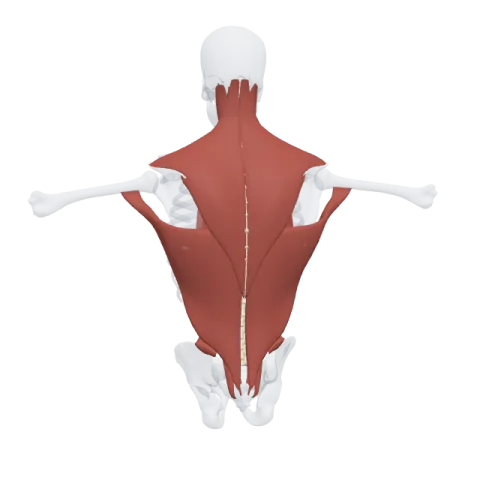
The quadratus lumborum is a thick, four-sided muscle deep in the lower back, between the twelfth rib and the top of the pelvis. It bends the lumbar spine to the side, steadies the last rib during breathing, and is supplied by the anterior rami of T12 to L4.
Where it is
The quadratus lumborum lies on each side of the lumbar spine, in the posterior abdominal wall. Seen from the front, after the abdominal organs are removed, it fills the space between the twelfth rib above, the iliac crest below and the lumbar vertebrae in the middle.
Its neighbors place it well:
- In front: the kidney, the colon and, near the spine, the psoas major. The subcostal, iliohypogastric and ilioinguinal nerves cross its front surface.
- Behind: the erector spinae, separated from it by a layer of the thoracolumbar fascia.
- Above: the diaphragm, whose lateral arcuate ligament arches over the top of the quadratus lumborum.
It is covered on the abdominal muscles page as the back part of the abdominal wall, and it is also studied with the deep back muscles because it moves the lumbar spine.
Origin and insertion
- Origin: the back part of the iliac crest of the hip bone and the iliolumbar ligament, which joins the transverse process of L5 to the ilium.
- Insertion: the medial half of the lower border of the twelfth rib, and the tips of the transverse processes of the first four lumbar vertebrae.
Its fibers run in more than one direction: some go from the iliac crest straight up to the rib, some from the crest to the transverse processes, and a few from the transverse processes up to the rib.
What it does
- Bends the lumbar spine to the side: one side contracting tilts the trunk toward that side. This is the action most exams expect.
- Hitches the hip: if the trunk is fixed, one side lifts the same side of the pelvis, as when you swing one leg forward without bending the knee.
- Steadies the twelfth rib: during deep breathing it holds the last rib down, giving the diaphragm a firm base to pull against.
- Helps extend the lumbar spine: both sides working together add to the pull of the erector spinae.
Innervation and blood supply
The quadratus lumborum is supplied by the anterior rami of T12 to L4: the subcostal nerve (T12) and branches of the upper lumbar nerves. This is a useful contrast with the erector spinae behind it, which take the posterior rami.
Blood comes from the lumbar arteries, the subcostal artery and the lumbar branch of the iliolumbar artery.
How to remember it
- Quadratus = square, lumborum = of the loins: a square muscle in the lower back.
- Rib, crest, processes: draw a box with the twelfth rib on top, the iliac crest at the bottom and the lumbar transverse processes on the inner side.
- Front rami, not back rami: it sits in front of the erector spinae and, like the psoas, gets anterior rami.
- The hip hiker: one side lifts the pelvis on the same side, which is why it is often called the hip hiker.
Look at the transverse processes of L1 to L4 on the bones of the spine page, then test yourself in the back quiz.
Frequently asked questions
What does the quadratus lumborum do?
One side bends the lumbar spine to that side and can lift the same side of the pelvis. Both sides steady the twelfth rib and help extend the lower back.
Where does the quadratus lumborum attach?
From the back of the iliac crest and the iliolumbar ligament to the twelfth rib and the transverse processes of L1 to L4.
What nerve supplies the quadratus lumborum?
The anterior rami of T12 to L4, that is the subcostal nerve and branches of the lumbar nerves.
Is the quadratus lumborum a back muscle or an abdominal muscle?
Both views are used. It forms part of the posterior abdominal wall, but it also moves the lumbar spine with the deep back muscles.
What lies in front of the quadratus lumborum?
The kidney, the colon and the psoas major, with the subcostal, iliohypogastric and ilioinguinal nerves crossing its surface.
