See them on the 3D body
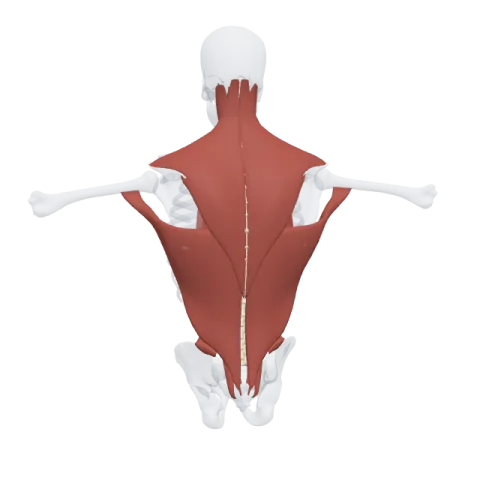
The lumbar vertebrae (l1-l5) lit on the 3D back, as in the back quiz. Turn the body, peel the layers, tap any structure for its name.
Quick answer
- Latin name
- Vertebrae lumbales
- Type
- Irregular bones (five lumbar vertebrae)
- Location
- Lower back, between the twelfth thoracic vertebra (T12) above and the sacrum below
The lumbar vertebrae are the five vertebrae of the lower back, L1 to L5, between the rib cage and the pelvis. They are the largest and heaviest vertebrae of the spine, because they carry the weight of the whole upper body, and they have neither rib facets nor holes in their transverse processes.
Where they are and what they touch
The lumbar spine sits behind the abdomen, at the level of the waist. Above it is T12, the last vertebra with ribs; below it is the sacrum, wedged between the two hip bones. It forms the lumbar curve, which is convex toward the front. This curve appears when a child starts to stand and walk.
The lumbar vertebrae protect the lowest part of the spinal cord and the bundle of nerve roots below it. The cord usually ends around the level of L1 or L2. Below that, the vertebral canal holds the cauda equina, the nerve roots that continue down to the lower lumbar and sacral levels. The bones of the spine page compares the lumbar region with the rest of the column.
Features of a lumbar vertebra
Body
The body is large, wider from side to side than front to back, and shaped a little like a kidney seen from above. The bodies grow bigger from L1 to L5 as the load increases.
Arch and vertebral foramen
The pedicles and laminae are short and thick. The vertebral foramen is triangular, larger than in the thoracic spine but smaller than in the neck.
Spinous process
The spinous process is short, broad and square, like the blade of a small hatchet. It points straight back, so there are clear gaps between neighboring spines, and the gaps widen when you bend forward.
Transverse processes
The transverse processes are long and thin. They represent fused rib elements, so they are sometimes called costal processes. Near their base, on the back, is a small accessory process, and on the back of each superior articular process is a rounded mammillary process. Deep back muscles grip both.
Articular processes
The facets of the lumbar vertebrae are curved and lie almost in a sagittal plane: the upper ones face inward, the lower ones face outward and fit between the upper facets of the vertebra below. This interlocking allows bending forward, backward and to the side, but blocks most rotation.
L1: the top of the lumbar spine
L1 is the smallest lumbar vertebra. It sits just below the twelfth ribs, and the diaphragm's crura begin on the front of its body. In many people the spinal cord ends at about this level.
L5: the lumbosacral vertebra
L5 is the largest lumbar vertebra and the most different:
- Its body is wedge-shaped, taller in front than behind. This helps create the angle between the lumbar spine and the sacrum.
- Its transverse processes are short, thick and cone-shaped, and they start from the body as well as the pedicles. The iliolumbar ligament ties them to the iliac crest of the hip bone.
- Its lower facets face more forward and meet the sacrum. The joint between L5 and the sacrum, the lumbosacral joint, carries a large share of the body's weight onto the pelvis.
Joints
- Intervertebral discs: the thickest of the spine, filling the spaces between the large bodies. They let the lower back bend and absorb load.
- Facet joints: synovial joints between the articular processes, which set the direction of movement.
- Lumbosacral joint: L5 on the sacrum, through a disc in front and two facet joints behind.
Muscles attached
Powerful muscles of the trunk and hip attach to the lumbar vertebrae:
- The psoas major starts on the sides of the bodies and discs from T12 to L4 and on the lumbar transverse processes, and runs down to the femur to flex the hip.
- The diaphragm is anchored by two crura: the right one on the bodies of L1 to L3, the left one on L1 and L2.
- The quadratus lumborum runs from the iliac crest to the twelfth rib and the transverse processes of L1 to L4. It bends the trunk to the side.
- The latissimus dorsi reaches the lumbar spines through the thoracolumbar fascia.
- The erector spinae and the multifidus are thick here and hold the lower back upright.
How to remember them
- Big, square and no extras. A big body, a square spine, no costal facets and no transverse foramina: the vertebra is lumbar.
- Moose head. Many students picture a lumbar vertebra as a moose head, with the long transverse processes as the antlers.
- Five for the pelvis. L5 is the wedge that meets the sacrum, and the one with the chunky transverse processes.
- Waist line. A line between the highest points of the iliac crests usually crosses the spine at about L4.
In Anatomy Atlas 3D
Each lumbar vertebra is a separate structure in the app, "Vertebra L1" to "Vertebra L5". Hide the muscles to see the facets interlock from behind, or turn the spine to see the wedge of L5 from the side. Practice naming them in the back quiz. The app is free on iPad and iPhone.
Frequently asked questions
Why are lumbar vertebrae so large?
They carry the weight of the head, arms and trunk, and the load increases toward the bottom of the spine.
What is special about L5?
It is the largest lumbar vertebra, its body is taller in front than behind, and its thick transverse processes start from the body. It joins the sacrum.
Where does the spinal cord end?
Usually around L1 or L2. Below that the canal contains the cauda equina, the nerve roots for the lower limbs and pelvis.
Why can the lower back bend but barely twist?
The lumbar facets lie in a nearly sagittal plane and lock together, which allows forward and backward bending but limits rotation.
