Muscle · Upper limb
Rhomboid minor: origin, insertion, action and innervation
The rhomboid minor runs from the C7 and T1 spines to the medial border of the scapula. It retracts the scapula; dorsal scapular nerve (C4–C5).
Quick answer
- Latin name
- Musculus rhomboideus minor
- Origin
- Lower part of the nuchal ligament and spinous processes of C7 and T1 (bones of the spine)
- Insertion
- Medial border of the scapula, at the level of the root of the spine
- Action
- Retracts the scapula and rotates it downward (tilts the glenoid cavity down); holds it against the chest wall
- Innervation
- Dorsal scapular nerve (C4–C5)
- Blood supply
- Dorsal scapular artery (or the deep branch of the transverse cervical artery)
See it on the 3D body
The rhomboid minor lit on the 3D back, as in the back quiz. Turn the body, peel the layers, tap any structure for its name.
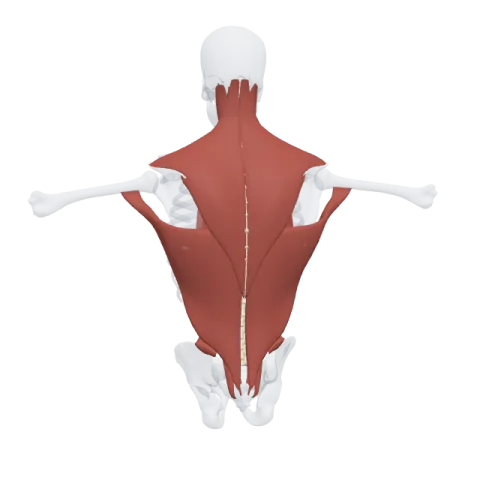
The rhomboid minor is a narrow, flat muscle of the upper back that runs from the spinous processes of C7 and T1 to the inner edge of the shoulder blade, level with the root of its spine. It pulls the scapula toward the spine and rotates it downward, and it is supplied by the dorsal scapular nerve.
Where it is
The rhomboid minor lies deep to the trapezius, at the junction of the neck and the back. You cannot see it on the surface: the trapezius covers it completely.
It forms the upper band of the rhomboid sheet. The rhomboid major lies just below it and is often fused with it, so that the two can be hard to tell apart. Just above the rhomboid minor, the levator scapulae comes down from the neck to the superior angle.
Its fibers run down and outward, from the midline to the scapula. The base of the neck, where C7 sticks out as the "vertebra prominens", is a good surface landmark for its origin.
Origin and insertion
- Origin: the lower part of the nuchal ligament and the spinous processes of C7 and T1 (see the bones of the spine).
- Insertion: the medial border of the scapula, at the level of the root of the spine of the scapula, the small smooth triangle where the spine meets the medial border.
So the three muscles on the medial border share it out: levator scapulae above the spine, rhomboid minor at the spine, rhomboid major below the spine down to the inferior angle.
What it does
The rhomboid minor works with the rhomboid major, and their actions are the same:
- Retraction of the scapula. It pulls the shoulder blade toward the spine, as when you squeeze your shoulder blades together or row a boat. The middle fibers of the trapezius help.
- Downward rotation of the scapula. It turns the scapula so that the glenoid cavity tilts down, which helps bring a raised arm back down.
- Holding the scapula flat. With the serratus anterior pulling from the front, the rhomboids keep the medial border pressed against the ribs.
Because its fibers climb from the scapula to vertebrae that sit higher, it can also help elevate the scapula.
Innervation and blood supply
Its nerve is the dorsal scapular nerve, with fibers from C5 and often C4. The nerve comes off the C5 root of the brachial plexus, passes through the middle scalene and runs down along the medial border of the scapula, deep to the levator scapulae and both rhomboids, supplying each one.
Its blood comes from the dorsal scapular artery, which in some people is replaced by the deep branch of the transverse cervical artery.
How to remember it
- Minor is higher. The rhomboid minor sits above the rhomboid major, opposite the spine of the scapula.
- Two vertebrae for the minor. Minor = C7 and T1 (two spines); major = T2 to T5 (four spines).
- Find the T3 level. The root of the scapular spine lies at about the level of the T3 spinous process. That is where the rhomboid minor inserts.
- One nerve for the column. The dorsal scapular nerve supplies all three muscles of that border.
Revise the muscles that pull the shoulder blades together on the muscles of the shoulder page, then find both rhomboids in the shoulder quiz.
Frequently asked questions
What is the action of the rhomboid minor?
It retracts the scapula toward the spine, rotates it downward and holds it against the chest wall, together with the rhomboid major.
What is the difference between the rhomboid minor and rhomboid major?
The rhomboid minor is smaller and higher: it comes from C7 and T1 and inserts at the root of the scapular spine. The rhomboid major comes from T2 to T5 and inserts below it, down to the inferior angle.
Which nerve supplies the rhomboid minor?
The dorsal scapular nerve, from roots C4 and C5.
Can you feel the rhomboid minor?
Not directly. The trapezius covers it, but you can feel the area tighten between the spine and the shoulder blade when you squeeze your shoulder blades together.
