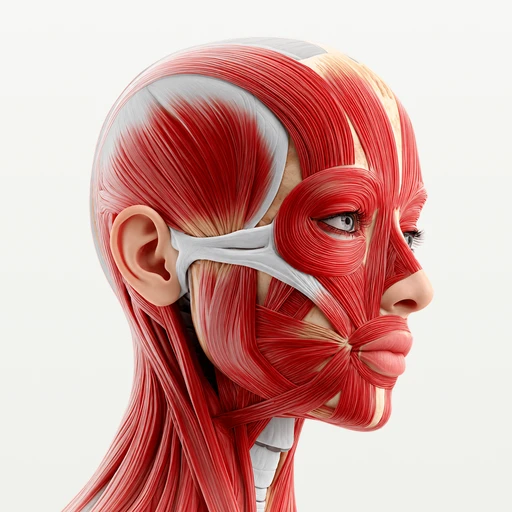
See them on the 3D body
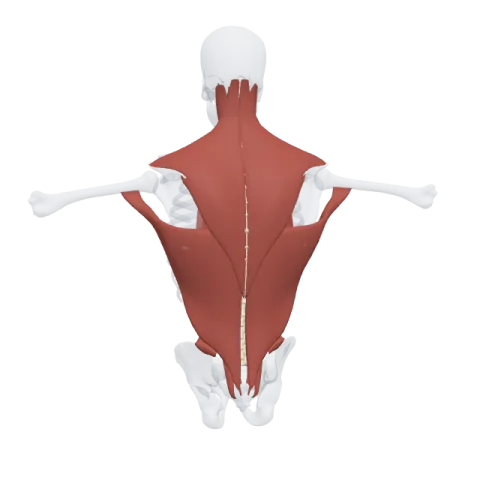
The thoracic vertebrae (t1-t12) lit on the 3D back, as in the back quiz. Turn the body, peel the layers, tap any structure for its name.
Quick answer
- Latin name
- Vertebrae thoracicae
- Type
- Irregular bones (twelve thoracic vertebrae)
- Location
- Back of the chest, between the seventh cervical vertebra (C7) above and the first lumbar vertebra (L1) below
- Joints
- Intervertebral discs and facet joints with the vertebrae above and below; costovertebral joints with the heads of the ribs; costotransverse joints with the tubercles of ribs 1 to 10
The thoracic vertebrae are the twelve vertebrae of the chest, numbered T1 to T12 from the neck down. They are the only vertebrae that join the ribs, and you can recognize them by the small joint surfaces for the ribs on their bodies and transverse processes, the costal facets.
Where they are and what they touch
The thoracic spine runs down the back of the chest, from the base of the neck to about the level of the lowest ribs. Above it lies C7, below it the first lumbar vertebra. It forms the thoracic curve, which is concave toward the front and makes room for the heart and lungs.
Each thoracic vertebra meets the vertebrae above and below through a disc and two facet joints, and meets a pair of ribs on each side. With the ribs and the sternum in front, the thoracic spine closes the rib cage, described on the bones of the rib cage page.
Features of a typical thoracic vertebra (T2 to T9)
Body and costal facets
The body is medium-sized and roughly heart-shaped seen from above. Each side carries two half-facets, or demifacets: one at the top edge and one at the bottom edge. The head of a rib sits in the notch formed by the lower demifacet of one vertebra, the disc, and the upper demifacet of the vertebra below. Rib 6, for example, touches the bodies of T5 and T6.
Transverse processes
The transverse processes are thick and point backward and out. On their front tip is a transverse costal facet, where the tubercle of the rib with the same number rests. So rib 6 also leans on the transverse process of T6.
Spinous process
The spinous process is long and thin and slopes steeply downward. In the middle of the thoracic spine, roughly T5 to T8, each spine overlaps the one below like roof tiles. The tip you feel under the skin is therefore lower than the body it belongs to.
Vertebral foramen and articular processes
The vertebral foramen is small and round: the spinal cord is narrower here. The articular facets are flat and lie almost in a frontal plane, facing back (upper ones) and forward (lower ones). This allows rotation, while the ribs and the overlapping spines limit bending.
T1: the transition from the neck
T1 still looks a little like a cervical vertebra: its body is wide from side to side. It has a full costal facet at the top of its body for the head of the first rib, which touches only T1, and a demifacet at the bottom for part of the second rib. Its spinous process is long and almost horizontal, and it is often the second bump you feel below C7.
T10, T11 and T12: the lower thoracic vertebrae
- T10 usually has a single facet for rib 10 near the top of its body, since that rib rests on one vertebra only.
- T11 and T12 each have one full costal facet, set partly on the pedicle, for ribs 11 and 12. They have no transverse costal facets: the floating ribs do not touch the transverse processes.
- T12 is the transitional vertebra. Its body is larger, close in size to a lumbar body, and its lower articular processes face sideways like those of the lumbar vertebrae. Its upper facets still look thoracic. The aorta passes behind the diaphragm at about the level of T12.
Joints
- Intervertebral discs between the bodies, thinner than in the neck and lower back.
- Facet joints between the articular processes.
- Costovertebral joints between the heads of the ribs and the bodies.
- Costotransverse joints between the tubercles of ribs 1 to 10 and the transverse processes.
The rib joints move when you breathe: the ribs swing up and out around them, so the chest gets wider.
Muscles attached
The thoracic spines and transverse processes anchor large back muscles:
- The trapezius starts on the spinous processes of all twelve thoracic vertebrae.
- The rhomboid minor starts on C7 and T1, and the rhomboid major on T2 to T5. Both pull the scapula toward the spine.
- The latissimus dorsi starts on the lower six thoracic spines, around T7 to T12, and on the thoracolumbar fascia.
- The erector spinae and the deeper transversospinal muscles run along the whole thoracic column and keep the spine upright.
- The psoas major starts in part on the side of the body of T12.
How to remember them
- Ribs mean thoracic. A vertebra with costal facets is thoracic. Holes in the transverse processes instead mean cervical; neither feature means lumbar.
- Giraffe and heart. Seen from the side, the long sloping spine looks like a giraffe's neck. Seen from above, the body is heart-shaped, which fits the chest.
- One facet, one vertebra. Ribs 1, 10, 11 and 12 each touch only one vertebra, so T1, T10, T11 and T12 carry full facets.
- Number match. The tubercle of a rib meets the transverse process of the vertebra with the same number.
In Anatomy Atlas 3D
The app shows each thoracic vertebra as its own structure, "Vertebra T1" to "Vertebra T12". Hide the ribs to see the costal facets, then show them again to see where each rib head lands. You can quiz these in the back quiz. The app is free on iPad and iPhone.
Frequently asked questions
How do you tell a thoracic vertebra from the others?
Look for costal facets on the body and on the transverse processes. Only thoracic vertebrae have them. They also have long, downward-sloping spines.
What is a demifacet?
A half joint surface on the edge of a thoracic body. Two demifacets, one on each of two vertebrae, together hold the head of one rib.
Why is T12 called a transitional vertebra?
Its upper part looks thoracic and its lower articular processes look lumbar, so it bridges the two regions.
Which thoracic vertebrae have no transverse costal facets?
T11 and T12, because ribs 11 and 12 do not reach the transverse processes.
Muscles that originate here
From the anatomical data behind Anatomy Atlas 3D (Z-Anatomy, reviewed). In the app, tap the bone, then each muscle around it to open its card.
