
Muscle · Head and neck
Digastric muscle: origin, insertion, action and innervation
The digastric has two bellies, from the mastoid notch and the mandible, slung to the hyoid. It opens the mouth and is supplied by CN V3 and CN VII.
Quick answer
- Latin name
- Musculus digastricus
- Origin
- Posterior belly: mastoid notch on the inner side of the mastoid process of the temporal bone. Anterior belly: digastric fossa on the inner surface of the mandible, near the midline
- Insertion
- Intermediate tendon, held to the body and greater horn of the hyoid bone by a fibrous loop
- Action
- Depresses the mandible (opens the mouth) when the hyoid is fixed; raises the hyoid during swallowing when the mandible is fixed
- Innervation
- Anterior belly: nerve to mylohyoid, from the mandibular nerve (CN V3). Posterior belly: digastric branch of the facial nerve (CN VII)
- Blood supply
- Anterior belly: submental artery. Posterior belly: occipital and posterior auricular arteries
See it on the 3D body
The digastric lit on the 3D neck, as in the neck quiz. Turn the body, peel the layers, tap any structure for its name.
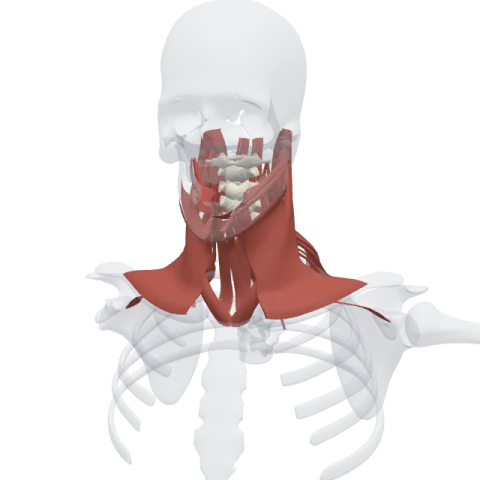
The digastric is a small muscle under the jaw made of two fleshy bellies joined by a round tendon that is slung to the hyoid bone. It opens the mouth by pulling the mandible down, and each belly has its own nerve.
Where it is
The digastric lies just below the lower border of the mandible, in the upper part of the front of the neck. It is one of the suprahyoid muscles, the group that sits above the hyoid bone, together with the mylohyoid, the stylohyoid and the geniohyoid.
Its shape is a shallow V or a hammock:
- The posterior belly starts behind the ear and runs down and forward.
- The two bellies meet at an intermediate tendon just above the hyoid bone. On its way, the tendon passes through a split in the stylohyoid muscle.
- The anterior belly runs from that tendon forward and up to the inside of the chin.
With the lower border of the mandible, the two bellies outline the submandibular triangle, the area that holds the submandibular salivary gland.
Origin and insertion
The digastric has no single origin and insertion in the usual sense. Its fixed points are both ends, and the middle tendon is anchored to the hyoid:
- Posterior belly: the mastoid notch, a groove on the inner side of the mastoid process of the temporal bone, part of the skull.
- Anterior belly: the digastric fossa, a shallow pit on the inner surface of the mandible, close to the midline.
- Intermediate tendon: tied to the body and greater horn of the hyoid by a loop of fibrous tissue, which lets it slide a little.
What it does
- Opens the mouth: when the infrahyoid muscles hold the hyoid still, the digastric pulls the chin down and back. It works with the lateral pterygoid, especially when you open wide or against resistance.
- Raises the hyoid: when the jaw is closed and fixed, the two bellies lift the hyoid bone. This happens at the start of swallowing.
- Pulls the hyoid backward or forward: the posterior belly alone draws it back and up; the anterior belly alone draws it forward.
Innervation and blood supply
The two bellies come from different pharyngeal arches and keep different nerves:
- Anterior belly: the nerve to mylohyoid, a branch of the inferior alveolar nerve from the mandibular division of the trigeminal nerve (CN V3). It also supplies the mylohyoid.
- Posterior belly: the digastric branch of the facial nerve (CN VII), given off soon after the nerve leaves the skull through the stylomastoid foramen.
The anterior belly receives blood from the submental artery, a branch of the facial artery. The posterior belly is supplied by the occipital and posterior auricular arteries.
How to remember it
- Di-gastric = two bellies: from the Greek for "two stomachs". Each belly has its own nerve.
- Front five, back seven: the anterior belly takes cranial nerve V (via V3), the posterior belly takes cranial nerve VII.
- Follow the neighbors: the anterior belly shares its nerve with the mylohyoid it lies on; the posterior belly shares its nerve with the stylohyoid it runs alongside.
- A tendon through a buttonhole: the intermediate tendon threads through the stylohyoid before reaching the hyoid.
Compare it with the jaw-closing temporalis, then test yourself in the neck quiz.
Frequently asked questions
What is the main action of the digastric muscle?
It depresses the mandible and opens the mouth when the hyoid is fixed. With the jaw fixed, it lifts the hyoid bone.
Why does the digastric have two nerves?
Each belly develops from a different pharyngeal arch. The anterior belly keeps the nerve of the first arch (CN V3) and the posterior belly keeps the nerve of the second arch (CN VII).
Where does the posterior belly of the digastric attach?
To the mastoid notch, a groove on the inner side of the mastoid process of the temporal bone.
Is the digastric a suprahyoid muscle?
Yes. It is one of the four suprahyoid muscles, with the mylohyoid, the stylohyoid and the geniohyoid.
