Muscle · Upper limb
Extensor carpi radialis brevis: origin, insertion, action and innervation
The ECRB runs from the lateral epicondyle to the third metacarpal. It extends and abducts the wrist and is supplied by the deep branch of the radial nerve.
Quick answer
- Latin name
- Musculus extensor carpi radialis brevis
- Origin
- Lateral epicondyle of the humerus (common extensor origin) and the radial collateral ligament of the elbow
- Insertion
- Back of the base of the third metacarpal
- Action
- Extends the wrist and abducts it (radial deviation); steadies the wrist when the fingers grip
- Innervation
- Deep branch of the radial nerve (C7-C8)
- Blood supply
- Radial artery and its radial recurrent branch
See it on the 3D body
The extensor carpi radialis brevis lit on the 3D forearm and hand, as in the forearm and hand quiz. Turn the body, peel the layers, tap any structure for its name.
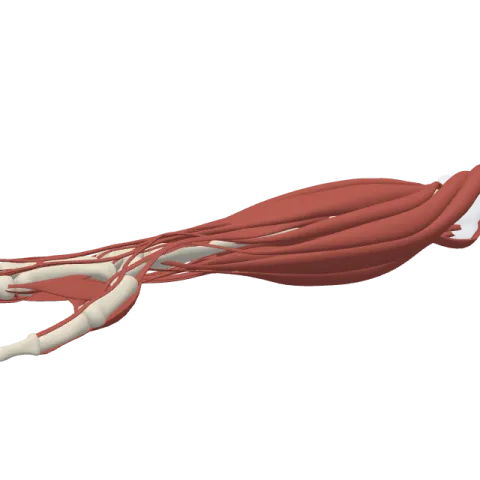
The extensor carpi radialis brevis is a superficial muscle on the back of the forearm that runs from the outer side of the elbow to the base of the third metacarpal. It extends the wrist, tilts it toward the thumb and holds it steady while the fingers grip. It is supplied by the deep branch of the radial nerve.
Where it is
The extensor carpi radialis brevis (ECRB) lies in the superficial layer of the posterior compartment of the forearm, on the thumb side. It sits just behind and partly under its longer twin, the extensor carpi radialis longus, and next to the extensor digitorum on the other side. In front of both radial extensors lies the brachioradialis, which forms the outer edge of the forearm.
The name lists its features: extensor (straightens), carpi (of the wrist), radialis (on the radius side), brevis (short). It is shorter than the longus because it starts lower, on the epicondyle rather than on the ridge above it.
In the lower forearm, the abductor pollicis longus and the extensor pollicis brevis cross over the two radial extensor tendons on their way to the thumb. At the wrist, the ECRB and ECRL tendons run together through the second extensor compartment, under the extensor retinaculum, on the back of the radius.
Origin and insertion
- Origin: the lateral epicondyle of the humerus, through the common extensor tendon it shares with the extensor digitorum, the extensor digiti minimi and the extensor carpi ulnaris. Some fibers also arise from the radial collateral ligament of the elbow.
- Insertion: the back of the base of the third metacarpal, the bone that lines up with the middle finger. The metacarpals page shows it.
The third metacarpal lies near the center of the wrist, so the ECRB pulls the hand almost straight back, with only a small tilt toward the thumb. The longus, which inserts on the second metacarpal, tilts the hand more.
What it does
- Extension of the wrist: it bends the hand back toward the back of the forearm.
- Abduction of the wrist (radial deviation): with the longus, it tilts the hand toward the thumb. When it works together with the extensor carpi ulnaris, the side pulls cancel and the wrist extends straight.
- Wrist stabilizer in grip: when you make a fist, the long finger flexors would also flex the wrist. The ECRB contracts to hold the wrist slightly extended, which keeps the finger flexors at a good length and makes the grip stronger.
Try it: make a tight fist and feel the back of your forearm just below the elbow. The muscle tightens even though the wrist does not move.
Innervation and blood supply
The ECRB is supplied by the deep branch of the radial nerve (roots C7 and C8). The radial nerve divides near the elbow into a superficial branch, for the skin, and a deep branch for muscles. The ECRB usually gets its twig from the deep branch before that branch enters the supinator and becomes the posterior interosseous nerve. In some people the twig comes from the superficial branch instead.
Its blood comes from the radial artery and its radial recurrent branch near the elbow.
Lateral epicondylitis, known as tennis elbow, is a painful condition of the common extensor origin, and the tendon of the ECRB is the one most often involved.
How to remember it
- Brevis hits the bull's-eye: it inserts on the third metacarpal, the middle of the hand. Longus lands on the second.
- Shorter muscle, lower start: brevis starts on the epicondyle, longus on the ridge above it.
- The fist muscle: every strong grip switches on the ECRB to keep the wrist from bending.
- Lateral epicondyle, extensors: the common extensor origin is on the outer side of the elbow; the flexors start on the inner side.
Test yourself in the forearm and hand quiz, and see how the extensors are layered on the muscles of the forearm page.
Frequently asked questions
What is the action of the extensor carpi radialis brevis?
It extends the wrist and tilts it toward the thumb (radial deviation). It also steadies the wrist during a strong grip.
Where does the extensor carpi radialis brevis insert?
On the back of the base of the third metacarpal.
Which nerve supplies the extensor carpi radialis brevis?
The deep branch of the radial nerve, from roots C7 and C8.
What is the difference between the extensor carpi radialis longus and brevis?
The longus starts higher, on the ridge above the lateral epicondyle, and inserts on the second metacarpal. The brevis starts on the lateral epicondyle and inserts on the third metacarpal.
