
Muscle · Upper limb
Extensor carpi ulnaris: origin, insertion, action and innervation
The extensor carpi ulnaris runs from the lateral epicondyle and ulna to the fifth metacarpal. It extends and adducts the wrist. Nerve: posterior interosseous.
Quick answer
- Latin name
- Musculus extensor carpi ulnaris
- Origin
- Humeral head: lateral epicondyle of the humerus (common extensor origin). Ulnar head: posterior border of the ulna
- Insertion
- Tubercle on the ulnar side of the base of the fifth metacarpal
- Action
- Extends the wrist and adducts it (ulnar deviation)
- Innervation
- Posterior interosseous nerve, from the deep branch of the radial nerve (C7-C8)
- Blood supply
- Posterior interosseous artery and branches of the ulnar artery
See it on the 3D body
The extensor carpi ulnaris lit on the 3D forearm and hand, as in the forearm and hand quiz. Turn the body, peel the layers, tap any structure for its name.
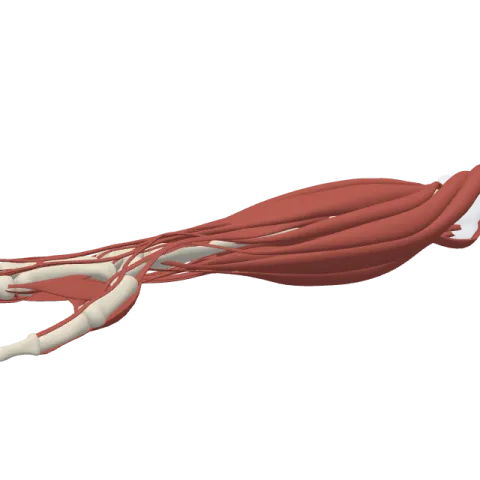
The extensor carpi ulnaris is the long, slim muscle along the little-finger side of the back of the forearm. It extends the wrist and tilts it toward the little finger (ulnar deviation), and despite its name it is supplied by a branch of the radial nerve, the posterior interosseous nerve.
Where it is
The extensor carpi ulnaris (ECU) is the most medial muscle of the superficial extensor layer. It runs along the back of the ulna, the bone you feel as a sharp ridge from the point of the elbow to the wrist. On its thumb side lies the extensor digiti minimi, then the extensor digitorum. The anconeus sits just above it near the elbow.
The name follows the usual pattern: extensor (straightens), carpi (of the wrist), ulnaris (on the ulna side). The word "ulnaris" describes its position only. It does not mean the ulnar nerve supplies it.
At the wrist, the ECU tendon runs in a groove next to the ulnar styloid process, the small bony point on the little-finger side of the back of the wrist. It passes through the sixth extensor compartment, the last of the six tunnels under the extensor retinaculum, inside its own sheath. Extend your wrist and tilt it toward the little finger: you can feel the tendon tighten beside the head of the ulna.
Origin and insertion
- Humeral head: the lateral epicondyle of the humerus, through the common extensor tendon.
- Ulnar head: the posterior border of the ulna, through a sheet of tendon shared with the flexor carpi ulnaris on the other side of the bone.
- Insertion: a small tubercle on the ulnar side of the base of the fifth metacarpal, the bone in line with the little finger. See the metacarpals.
What it does
- Extension of the wrist: it bends the hand back, working with the extensor carpi radialis brevis and longus. Together, the radial and ulnar extensors cancel each other's side pull and the wrist extends straight back.
- Adduction of the wrist (ulnar deviation): with the flexor carpi ulnaris, it tilts the hand toward the little finger. The ECU pulls back and the FCU pulls forward, so the two together produce a clean sideways tilt.
- Wrist stability: like the other wrist extensors, it contracts during a strong grip to stop the finger flexors from bending the wrist.
The wrist tilts further toward the little finger than toward the thumb. One reason is bony: the radius reaches lower than the ulna, so the thumb side of the wrist runs into bone sooner. The ECU works hard whenever you use this range, for example when you swing a hammer down.
Innervation and blood supply
The ECU is supplied by the posterior interosseous nerve (roots C7 and C8). This nerve is the continuation of the deep branch of the radial nerve after it passes through the supinator. Every muscle of the posterior compartment depends on the radial nerve or its branches, and the ECU is no exception.
Its blood comes from the posterior interosseous artery, with small branches from the ulnar artery.
How to remember it
- Ulnaris is a place, not a nerve: the ECU lies on the ulna side but takes the radial nerve's posterior interosseous branch, like every extensor.
- Two ulnaris muscles, one tilt: the extensor carpi ulnaris at the back and the flexor carpi ulnaris at the front both pull the hand toward the little finger.
- Last in line, last tunnel: the ECU is the last superficial extensor on the little-finger side, and its tendon uses the sixth and last extensor compartment.
- Fifth for the ulna side: the radial extensors land on the second and third metacarpals; the ulnar extensor lands on the fifth.
Test yourself in the forearm and hand quiz, and compare the front and back compartments on the muscles of the forearm page.
Frequently asked questions
What is the action of the extensor carpi ulnaris?
It extends the wrist and adducts it, tilting the hand toward the little finger.
Is the extensor carpi ulnaris supplied by the ulnar nerve?
No. It is supplied by the posterior interosseous nerve, a branch of the radial nerve, from roots C7 and C8.
Where does the extensor carpi ulnaris insert?
On a tubercle on the ulnar side of the base of the fifth metacarpal.
Which muscles produce ulnar deviation of the wrist?
The extensor carpi ulnaris and the flexor carpi ulnaris, working together.
