Muscle · Trunk
Longissimus muscle: origin, insertion, action and innervation
The longissimus runs from the sacrum to the ribs, transverse processes and mastoid. It extends the spine and head and is supplied by posterior rami.
Quick answer
- Latin name
- Musculus longissimus
- Origin
- Common tendon of the erector spinae on the sacrum and the lumbar spinous processes; transverse processes of the upper thoracic vertebrae and articular processes of the lower cervical vertebrae for the upper parts
- Insertion
- Transverse processes of the thoracic and cervical vertebrae, the ribs between their tubercles and angles, and the mastoid process of the temporal bone
- Action
- Both sides: extend the vertebral column and, through the capitis part, the head. One side: bends the trunk and neck to the same side and turns the face to the same side
- Innervation
- Lateral branches of the posterior (dorsal) rami of the cervical, thoracic and lumbar spinal nerves
- Blood supply
- Posterior intercostal, subcostal and lumbar arteries; deep cervical and occipital arteries in the neck
See it on the 3D body
The longissimus lit on the 3D back, as in the back quiz. Turn the body, peel the layers, tap any structure for its name.
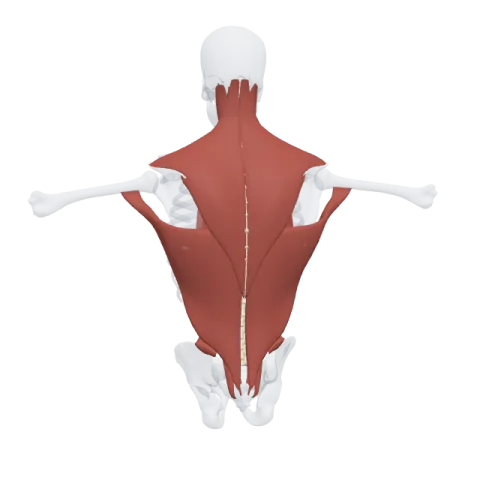
The longissimus is the middle column of the erector spinae and the largest and longest of its three columns. It runs from the sacrum all the way to the skull, extending the spine when both sides work and, through its top part, extending the head.
Where it is
The longissimus lies between the iliocostalis on the outside and the spinalis on the inside. In the lower back, the three columns share a thick common tendon and are hard to separate; they divide as they climb.
It is the column that lines up with the transverse processes, the side projections of the vertebrae. Its slips attach to these processes level after level, like a ladder running up each side of the spine. The thoracic part forms most of the muscle bulk you see on either side of the spine in the middle of the back.
In the neck, the longissimus passes deep to the splenius capitis and the splenius cervicis.
Origin and insertion
The longissimus has three parts:
- Longissimus thoracis: from the common tendon on the sacrum, the lumbar spinous processes and the transverse processes of the lumbar vertebrae, to the transverse processes of all the thoracic vertebrae and the lower nine or ten ribs, between their tubercles and angles.
- Longissimus cervicis: from the transverse processes of the upper four or five thoracic vertebrae to the posterior tubercles of the transverse processes of C2 to C6.
- Longissimus capitis: from the transverse processes of the upper thoracic vertebrae and the articular processes of the lower cervical vertebrae, to the back of the mastoid process of the temporal bone, on the skull.
What it does
- Extends the spine: both sides together pull the vertebral column back into line and keep it upright against gravity.
- Extends the head: the capitis part, acting on both sides, tips the head back.
- Bends to the side: one side alone tilts the trunk or the neck toward that side.
- Turns the face: one longissimus capitis turns the face toward the same side, because it pulls on the mastoid process from behind and below.
Innervation and blood supply
The longissimus is supplied segment by segment by the lateral branches of the posterior (dorsal) rami of the cervical, thoracic and lumbar spinal nerves. Each slip takes the nerve of its own level, which is the pattern for all the deep back muscles.
Its blood comes from the posterior intercostal, subcostal and lumbar arteries in the trunk, and from the deep cervical and occipital arteries in the neck.
How to remember it
- Longissimus = the longest: it is Latin for "longest". It is the only erector spinae column that runs from the sacrum to the skull.
- The middle child: in the order iliocostalis, longissimus, spinalis, it stands in the middle.
- Transverse process track: iliocostalis on rib angles, longissimus on transverse processes, spinalis on spinous processes.
- Mastoid twins: the longissimus capitis and the splenius capitis both reach the mastoid process, and both turn the face to their own side.
See how the transverse processes change from the neck to the lower back on the bones of the spine page. Test yourself in the back quiz.
Frequently asked questions
What does the longissimus muscle do?
Both sides extend the vertebral column and, through the capitis part, the head. One side bends the trunk and neck to that side.
Is the longissimus the longest erector spinae column?
Yes. Its name means "longest", and it is the only column that runs from the sacrum to the mastoid process of the skull.
What are the parts of the longissimus?
The longissimus thoracis, cervicis and capitis.
Where does the longissimus capitis insert?
On the back of the mastoid process of the temporal bone.
