
Latissimus dorsi: origin, insertion, action and innervation
The latissimus dorsi arises from the lower thoracic spine, thoracolumbar fascia, iliac crest and lower ribs and inserts in the intertubercular groove of the humerus. It extends, adducts and medially rotates the arm.
Quick answer
- Latin name
- Musculus latissimus dorsi
- Origin
- Spinous processes of T7–T12, thoracolumbar fascia, iliac crest of the hip bone, lower 3–4 ribs (and often the inferior angle of the scapula)
- Insertion
- Floor of the intertubercular groove of the humerus
- Action
- Extends, adducts and medially rotates the arm; pulls the body up towards a fixed arm
- Innervation
- Thoracodorsal nerve (C6–C8)
- Blood supply
- Thoracodorsal artery
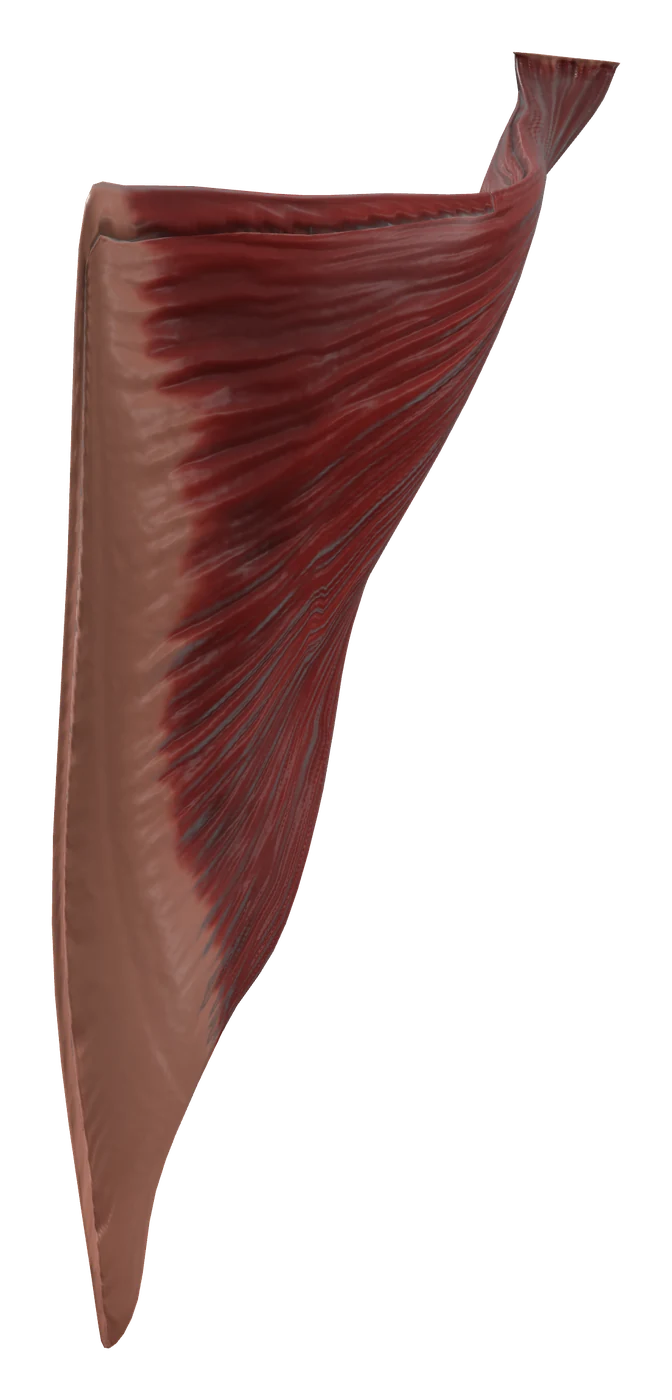
Latissimus dorsi means "the broadest muscle of the back". It covers most of the lower back and sides of the trunk, and ends on a narrow tendon on the front of the humerus.
Where it is
The latissimus is a large, flat, triangular sheet. It starts low in the back, sweeps up and outwards across the lower ribs and the bottom of the scapula, and twists into the back wall of the armpit before reaching the humerus. Its upper border is partly covered by the trapezius.
Origin and insertion
- Origin: the spinous processes of the lower six thoracic vertebrae, the thoracolumbar fascia (through which it reaches the lumbar and sacral spines), the back of the iliac crest and the lower three or four ribs. A slip often comes from the inferior angle of the scapula.
- Insertion: the floor of the intertubercular groove of the humerus, between the pectoralis major (lateral lip) and the teres major (medial lip).
What it does
- Extension of the arm: pulls a raised arm down and back, as in swimming or rowing.
- Adduction: brings the arm to the side.
- Medial rotation: turns the arm inwards.
- With the arm fixed above the head, it pulls the trunk up, which is why it's the key muscle of pull-ups and climbing.
Innervation and blood supply
The thoracodorsal nerve (C6–C8), a branch of the posterior cord of the brachial plexus, supplies it, along with the thoracodorsal artery.
How to remember it
- "Lat" = lateral and large: the widest muscle of the back.
- It's the "swimmer's muscle": arm up, then pull down and back.
- In the bicipital groove, the latissimus takes the floor.
Frequently asked questions
What is the main action of the latissimus dorsi?
It extends, adducts and medially rotates the arm, and lifts the body towards a fixed arm, as in a pull-up.
Where does the latissimus dorsi insert?
On the floor of the intertubercular groove of the humerus.
Which nerve supplies the latissimus dorsi?
The thoracodorsal nerve, from roots C6 to C8.