
Muscle · Upper limb
Flexor pollicis brevis: origin, insertion, action and innervation
The flexor pollicis brevis runs from the trapezium to the thumb's proximal phalanx. It flexes the thumb's base; median and ulnar nerves supply it.
Quick answer
- Latin name
- Musculus flexor pollicis brevis
- Origin
- Superficial head: flexor retinaculum and tubercle of the trapezium. Deep head: trapezoid and capitate (carpal bones)
- Insertion
- Radial side of the base of the proximal phalanx of the thumb, through a sesamoid bone
- Action
- Flexes the thumb at the metacarpophalangeal joint; helps flex the carpometacarpal joint during opposition
- Innervation
- Superficial head: recurrent branch of the median nerve (C8-T1). Deep head: deep branch of the ulnar nerve (C8-T1)
- Blood supply
- Superficial palmar branch of the radial artery
See it on the 3D body
The flexor pollicis brevis lit on the 3D forearm and hand, as in the forearm and hand quiz. Turn the body, peel the layers, tap any structure for its name.
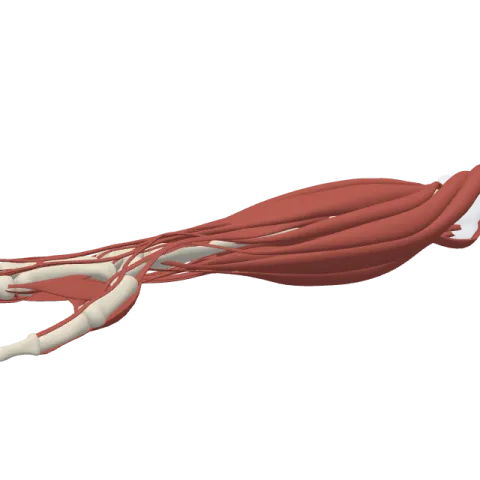
The flexor pollicis brevis is a short muscle in the ball of the thumb that bends the thumb at its metacarpophalangeal joint, the knuckle at the base of the thumb. It has two heads with two different nerves: the recurrent branch of the median nerve for the superficial head and the deep branch of the ulnar nerve for the deep head.
Where it is
The flexor pollicis brevis is one of the three thenar muscles, which make up the fleshy pad at the base of the thumb (the thenar eminence). Two of them lie side by side near the surface: the abductor pollicis brevis on the outer edge and the flexor pollicis brevis just inside it, toward the middle of the palm. The third, the opponens pollicis, lies underneath both.
Pollicis comes from pollex, the Latin word for thumb, and brevis means short. The name separates it from the flexor pollicis longus, the long forearm muscle whose tendon runs right beside it on the way to the tip of the thumb.
Its superficial head is the larger part and the one you feel in the ball of the thumb. The deep head is small, lies deeper in the palm and varies a lot from one person to another.
Origin and insertion
- Superficial head: the flexor retinaculum, the band that roofs the carpal tunnel, and the tubercle of the trapezium (see the carpal bones).
- Deep head: the trapezoid and the capitate, on the floor of the carpal tunnel.
- Insertion: the radial (thumb) side of the base of the proximal phalanx of the thumb (see the phalanges of the hand). Its tendon contains a small sesamoid bone where it crosses the metacarpophalangeal joint.
So the muscle crosses two joints of the thumb: the carpometacarpal joint at the wrist and the metacarpophalangeal joint at the base of the thumb. It stops before the interphalangeal joint.
What it does
- Flexes the thumb at the metacarpophalangeal joint: it bends the knuckle at the base of the thumb, so the thumb folds across the palm.
- Helps opposition: by flexing the thumb at the carpometacarpal joint as well, it works with the opponens pollicis and the abductor pollicis brevis to bring the thumb pad toward the fingers.
It acts whenever the thumb presses down on something with the tip held fairly straight: pressing a doorbell, holding a phone and scrolling with the thumb, or gripping a pen against the side of the index finger. Bending the very tip of the thumb is a different job, done by the flexor pollicis longus.
Innervation and blood supply
The flexor pollicis brevis is one of the few hand muscles that can receive two nerves:
- the superficial head is supplied by the recurrent branch of the median nerve (C8-T1), which also supplies the other two thenar muscles;
- the deep head is supplied by the deep branch of the ulnar nerve (C8-T1).
The pattern varies: in some people one nerve supplies the whole muscle. Its blood comes from the superficial palmar branch of the radial artery.
How to remember it
- Brevis stops at the base: the short flexor stops on the proximal phalanx; the long flexor goes on to the distal phalanx.
- Deep head, deep branch: the deep head gets the deep branch of the ulnar nerve. The superficial head stays with the median nerve, like the rest of the thenar group.
- Outside in, A then F: on the surface of the thenar pad, the abductor is on the outer edge and the flexor is next to it. The opponens hides underneath.
- Trapezium under the thumb: the superficial head starts on the trapezium, the carpal bone right at the base of the thumb.
The bones of the hand page shows where these carpal bones sit. Test yourself in the forearm and hand quiz.
Frequently asked questions
What does the flexor pollicis brevis do?
It flexes the thumb at the metacarpophalangeal joint and helps bring the thumb across the palm during opposition.
Which nerve supplies the flexor pollicis brevis?
The superficial head is supplied by the recurrent branch of the median nerve, and the deep head by the deep branch of the ulnar nerve.
Is the flexor pollicis brevis a thenar muscle?
Yes. The thenar muscles are the abductor pollicis brevis, the flexor pollicis brevis and the opponens pollicis.
What is the difference between flexor pollicis brevis and longus?
The brevis is a short hand muscle that bends the base of the thumb. The longus comes from the forearm, and its tendon reaches the distal phalanx to bend the tip of the thumb.
