
Muscle · Upper limb
Flexor pollicis longus: origin, insertion, action and innervation
The flexor pollicis longus runs from the radius to the thumb's distal phalanx. It bends the thumb tip; supplied by the anterior interosseous nerve.
Quick answer
- Latin name
- Musculus flexor pollicis longus
- Origin
- Anterior surface of the radius and the adjacent interosseous membrane; sometimes a small slip from the coronoid process of the ulna
- Insertion
- Palmar surface of the base of the distal phalanx of the thumb (phalanges of the hand)
- Action
- Flexes the interphalangeal joint of the thumb (the only muscle that can); also flexes the metacarpophalangeal and carpometacarpal joints of the thumb
- Innervation
- Anterior interosseous nerve, a branch of the median nerve (C8-T1)
- Blood supply
- Anterior interosseous artery
See it on the 3D body
The flexor pollicis longus lit on the 3D forearm and hand, as in the forearm and hand quiz. Turn the body, peel the layers, tap any structure for its name.
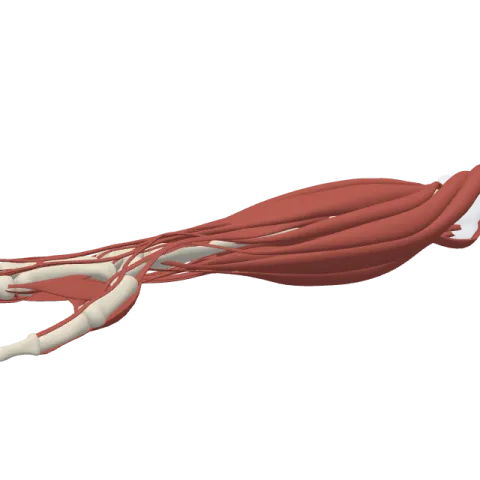
The flexor pollicis longus is the long flexor of the thumb: it runs from the front of the radius, through the carpal tunnel, to the last bone of the thumb. It is the only muscle that bends the tip of the thumb, at the interphalangeal joint, and it is supplied by the anterior interosseous nerve.
Where it is
The flexor pollicis longus (FPL) lies in the deep layer of the anterior forearm, on the radius side. It sits on the front of the radius, next to the flexor digitorum profundus, which covers the ulna. The flexor digitorum superficialis and the superficial flexors lie in front of it, and the pronator quadratus lies behind its tendon near the wrist.
Its fibers run down to one side of a single tendon, a feather-like (unipennate) arrangement. The tendon passes through the carpal tunnel as the structure closest to the thumb side, wrapped in its own synovial sheath. It then runs between the thenar muscles at the base of the thumb and enters a fibrous sheath along the palm side of the thumb, which keeps it close to the bone when the thumb bends.
Pollex is Latin for thumb, and longus separates it from the short thumb flexor in the hand, the flexor pollicis brevis.
Origin and insertion
- Origin: the anterior surface of the radius, from just below the radial tuberosity to near the pronator quadratus, and the adjacent part of the interosseous membrane. In some people a small extra slip comes from the coronoid process of the ulna.
- Insertion: the palmar surface of the base of the distal phalanx of the thumb (see the phalanges of the hand).
What it does
- Bends the tip of the thumb: it flexes the interphalangeal joint of the thumb. No other muscle does this.
- Bends the rest of the thumb: it also flexes the metacarpophalangeal and carpometacarpal joints as it pulls.
- Weakly helps flex the wrist, because its tendon crosses the front of the wrist.
It matters most in a precise pinch, when the tip of the thumb presses against the tip of the index finger: picking up a coin, threading a needle or holding a pencil. In this movement it works as a pair with the index part of the profundus.
When the anterior interosseous nerve is damaged, both of these muscles weaken and the person can no longer make a round "OK" circle with the thumb and index finger; the two tips flatten against each other instead.
Innervation and blood supply
The FPL is supplied by the anterior interosseous nerve (C8-T1; some books give C7-C8), a branch of the median nerve that leaves it near the elbow. The nerve runs down on the front of the interosseous membrane, between the FPL and the profundus, and supplies three deep muscles: the FPL, the lateral half of the profundus and the pronator quadratus.
Its blood comes from the anterior interosseous artery, which travels with the nerve, with small branches from the radial artery.
How to remember it
- Longus reaches the last bone: the long thumb flexor goes all the way to the distal phalanx, the short one stops on the proximal phalanx.
- One thumb, one tip-bender: the thumb has a single long flexor; the four fingers share the profundus.
- The anterior interosseous trio: FPL, half of FDP, pronator quadratus. All three lie in the deep layer, right on the interosseous membrane.
- Round O, bent tip: a round O between thumb and index needs the thumb tip to bend, which is the FPL's job.
The muscles of the forearm page places it among the deep flexors. Test yourself in the forearm and hand quiz.
Frequently asked questions
Which muscle bends the tip of the thumb?
The flexor pollicis longus. It is the only muscle that flexes the interphalangeal joint of the thumb.
What nerve supplies the flexor pollicis longus?
The anterior interosseous nerve, a branch of the median nerve.
Does the flexor pollicis longus pass through the carpal tunnel?
Yes. Its tendon passes through the carpal tunnel on the thumb side, in its own synovial sheath.
Where does the flexor pollicis longus originate?
On the anterior surface of the radius and the neighboring interosseous membrane, with an occasional small slip from the ulna.
