Muscle · Upper limb
Opponens pollicis: origin, insertion, action and innervation
The opponens pollicis runs from the trapezium to the first metacarpal. It opposes the thumb and is supplied by the recurrent branch of the median nerve.
Quick answer
- Latin name
- Musculus opponens pollicis
- Origin
- Tubercle of the trapezium (carpal bones) and the flexor retinaculum
- Insertion
- Whole lateral (radial) border of the shaft of the first metacarpal (metacarpals)
- Action
- Opposes the thumb by flexing and medially rotating the first metacarpal at the carpometacarpal joint
- Innervation
- Recurrent (thenar) branch of the median nerve (C8-T1)
- Blood supply
- Superficial palmar branch of the radial artery
See it on the 3D body
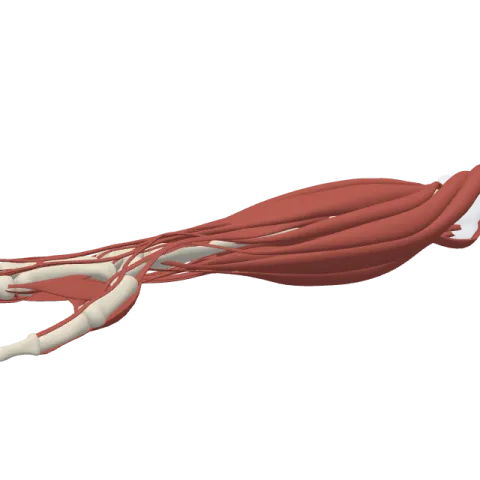
The opponens pollicis lit on the 3D forearm and hand, as in the forearm and hand quiz. Turn the body, peel the layers, tap any structure for its name.
The opponens pollicis is the deep muscle of the ball of the thumb that swings the first metacarpal across the palm and rotates it, so the pad of the thumb faces the pads of the fingers. This movement is called opposition, and the muscle is supplied by the recurrent (thenar) branch of the median nerve.
Where it is
The opponens pollicis is the deepest of the three thenar muscles at the base of the thumb. The abductor pollicis brevis and the flexor pollicis brevis cover it, and it lies directly on the front and outer side of the first metacarpal. You can feel it only as part of the general firmness of the thenar pad when you touch the thumb to the little finger.
It is the only thenar muscle that inserts on the metacarpal instead of the proximal phalanx. That is the key to its action: it moves the first metacarpal at its base, which carries the whole thumb with it.
Its partner on the other side of the palm is the opponens digiti minimi, which turns the little finger toward the thumb. When both contract, the thumb and little finger meet in the middle and the palm becomes a deep cup.
Origin and insertion
- Origin: the tubercle of the trapezium, the carpal bone at the base of the thumb, and the flexor retinaculum next to it (see the carpal bones).
- Insertion: the whole length of the lateral (radial) border of the shaft of the first metacarpal, and part of its palmar surface (see the metacarpals).
What it does
The opponens pollicis acts at the carpometacarpal joint of the thumb, the saddle joint between the trapezium and the first metacarpal. This joint allows a wide range of movement, which is what lets the thumb reach every finger.
- Flexion of the first metacarpal: it pulls the metacarpal forward and across the palm.
- Medial rotation of the first metacarpal: it turns the bone around its long axis so the thumb pad faces the fingers instead of facing forward.
Together these produce opposition. The abductor pollicis brevis and the flexor pollicis brevis help, and the adductor pollicis then presses the thumb firmly against the fingers. Opposition is what lets you pick up a coin, turn a jar lid or grip a cup by its handle.
Long-standing pressure on the median nerve in the carpal tunnel can weaken the thenar muscles, the opponens among them, and flatten the ball of the thumb.
Innervation and blood supply
The opponens pollicis is supplied by the recurrent branch of the median nerve (C8-T1), also called the thenar branch. It leaves the median nerve just after the carpal tunnel and curves back up into the thenar muscles.
Its blood comes from the superficial palmar branch of the radial artery, which crosses the thenar muscles.
How to remember it
- Recurrent means turning back: the nerve turns back up into the ball of the thumb to reach the opponens.
- The thumb sits on the trapezium: the muscle starts on the trapezium, the carpal bone right under the thumb.
- Metacarpal, not phalanx: of the three thenar muscles, only the opponens stops on a metacarpal, so it moves the thumb from its base.
- Touch each fingertip: run your thumb tip along each finger pad from index to little finger. The farther you go, the harder the opponens works.
The bones of the hand page shows the trapezium and first metacarpal. Test yourself in the forearm and hand quiz.
Frequently asked questions
What is opposition of the thumb?
It is the movement that brings the pad of the thumb against the pads of the fingers. It combines flexion and medial rotation of the first metacarpal.
What nerve supplies the opponens pollicis?
The recurrent branch of the median nerve, also called the thenar branch.
Where does the opponens pollicis insert?
Along the whole lateral border of the shaft of the first metacarpal.
What is the difference between the opponens pollicis and the adductor pollicis?
The opponens turns the thumb across the palm to face the fingers and is supplied by the median nerve. The adductor pulls the thumb toward the palm and is supplied by the ulnar nerve.
