
Muscle · Head and neck
Hyoglossus muscle: origin, insertion, action and innervation
The hyoglossus runs from the hyoid bone to the side of the tongue. It pulls the tongue down and back and is supplied by the hypoglossal nerve (CN XII).
Quick answer
- Latin name
- Musculus hyoglossus
- Origin
- Body and greater horn of the hyoid bone
- Insertion
- Side and underside of the tongue, blending with the styloglossus and the intrinsic tongue muscles
- Action
- Depresses and retracts the tongue
- Innervation
- Hypoglossal nerve (CN XII)
- Blood supply
- Lingual artery, which runs deep to the muscle
See it on the 3D body
The hyoglossus lit on the 3D neck, as in the neck quiz. Turn the body, peel the layers, tap any structure for its name.
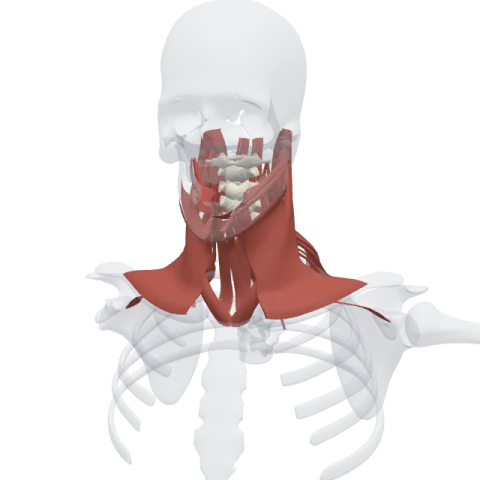
The hyoglossus is a thin, four-sided muscle that runs up from the hyoid bone into the side of the tongue. It pulls the tongue down and back, and like almost every tongue muscle it is supplied by the hypoglossal nerve.
Where it is
The hyoglossus is one of the extrinsic muscles of the tongue, the muscles that start outside the tongue and move it as a whole. The others are the genioglossus (from the chin), the styloglossus (from the styloid process) and the palatoglossus (from the soft palate).
It sits on the side of the tongue, deep to the mylohyoid, in the space between the tongue and the mandible. Low down, near the hyoid, the stylohyoid and the intermediate tendon of the digastric lie against its outer surface. It works as a landmark because several structures cross its outer surface while one important artery hides behind it:
- On its outer surface, from top to bottom: the lingual nerve, the duct of the submandibular gland and the hypoglossal nerve.
- Deep to it: the lingual artery, which passes under its back edge on the way into the tongue.
Origin and insertion
- Origin: the upper border of the body and greater horn of the hyoid bone. The hyoid is a U-shaped bone in the upper neck that does not join any other bone directly.
- Insertion: the side of the tongue, where its fibers mix with those of the styloglossus coming in from behind and with the tongue's own intrinsic muscles.
Its fibers run almost straight up, so the muscle looks like a flat rectangle from the side.
What it does
- Depresses the tongue: it pulls the sides of the tongue downward, flattening it.
- Retracts the tongue: because the hyoid lies below and behind the tongue, the pull also draws the tongue backward.
These movements help shape the tongue during chewing, swallowing and speech, and work against the genioglossus, which pushes the tongue forward.
Innervation and blood supply
The hyoglossus is supplied by the hypoglossal nerve (CN XII). You can see the nerve lying right on the muscle's outer surface before it sends branches into the tongue.
The rule to know: all the tongue muscles, intrinsic and extrinsic, are supplied by the hypoglossal nerve except the palatoglossus, which gets its supply from the vagus nerve through the pharyngeal plexus.
Blood comes from the lingual artery, a branch of the external carotid artery. It runs deep to the hyoglossus and gives off branches to the back of the tongue and to the floor of the mouth.
How to remember it
- Hyo-glossus, hyoid to tongue: glossa is Greek for "tongue". Its name gives you the route.
- "-glossus" means CN XII, with one exception: genioglossus, hyoglossus and styloglossus all take the hypoglossal nerve. Only the palatoglossus breaks the rule.
- Nerve outside, artery inside: the hypoglossal nerve lies on the hyoglossus, the lingual artery lies under it.
- Down and back: the hyoid sits below and behind the tongue, so pulling toward it can only bring the tongue down and back.
Look at the cartilages just below the hyoid on the larynx page, then test yourself in the neck quiz.
Frequently asked questions
What does the hyoglossus do?
It depresses and retracts the tongue, pulling it down and back toward the hyoid bone.
What nerve supplies the hyoglossus?
The hypoglossal nerve (CN XII), which lies on the outer surface of the muscle.
Is the hyoglossus an extrinsic tongue muscle?
Yes. It is one of the four extrinsic muscles of the tongue, with the genioglossus, the styloglossus and the palatoglossus.
What passes deep to the hyoglossus?
The lingual artery. The hypoglossal nerve, the lingual nerve and the submandibular duct run on its outer surface instead.
