Muscle · Upper limb
Opponens digiti minimi: origin, insertion, action and innervation
The opponens digiti minimi runs from the hamate to the fifth metacarpal. It opposes the little finger; supplied by the deep branch of the ulnar nerve.
Quick answer
- Latin name
- Musculus opponens digiti minimi manus
- Origin
- Hook of the hamate (carpal bones) and the flexor retinaculum
- Insertion
- Medial (ulnar) border of the shaft of the fifth metacarpal (metacarpals)
- Action
- Opposes the little finger: flexes the fifth metacarpal at the carpometacarpal joint and rotates it laterally, toward the thumb
- Innervation
- Deep branch of the ulnar nerve (C8-T1)
- Blood supply
- Deep palmar branch of the ulnar artery
See it on the 3D body
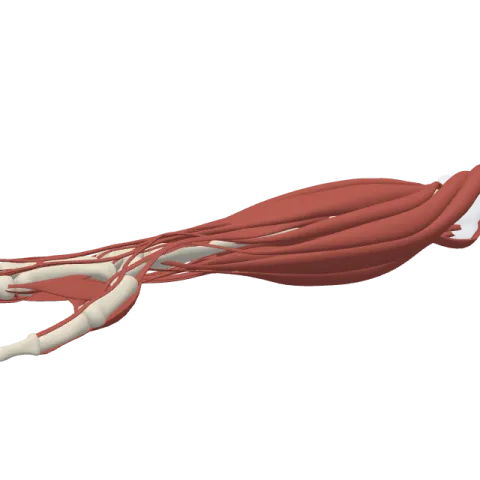
The opponens digiti minimi muscle of hand lit on the 3D forearm and hand, as in the forearm and hand quiz. Turn the body, peel the layers, tap any structure for its name.
The opponens digiti minimi is the deepest of the three hypothenar muscles, in the fleshy pad on the little-finger side of the palm. It runs from the hook of the hamate to the fifth metacarpal and turns that bone forward and toward the thumb, so the little finger can meet the thumb. It is supplied by the deep branch of the ulnar nerve.
Where it is
The edge of the palm below the little finger is padded by the hypothenar eminence, made of three muscles. Two lie near the surface: the abductor digiti minimi along the outer edge of the hand and the flexor digiti minimi brevis just beside it. The opponens digiti minimi lies underneath them, directly on the fifth metacarpal, so you cannot see it without lifting the other two.
Its name means "the opposer of the smallest finger": digitus is a finger and minimus the smallest. It is the mirror image of the opponens pollicis on the thumb side. Both start on the flexor retinaculum and a carpal bone, and both end along the shaft of a metacarpal rather than on a phalanx.
The deep branch of the ulnar nerve and the deep palmar branch of the ulnar artery pass between the abductor and the short flexor, then through the opponens, on their way into the deep part of the palm.
Origin and insertion
- Origin: the hook of the hamate, the curved projection you can press on in the palm below the ring finger, and the neighboring part of the flexor retinaculum (see the carpal bones).
- Insertion: the whole length of the medial (ulnar) border of the shaft of the fifth metacarpal, along the outer edge of the palm (see the metacarpals).
Because it stops on the metacarpal, the muscle does not cross the joints of the little finger itself. It moves the whole fifth ray at its base.
What it does
- Flexes the fifth metacarpal at the carpometacarpal joint, pulling it forward into the palm.
- Rotates the fifth metacarpal laterally, turning the little finger so that its pad faces the thumb.
Together these movements are called opposition of the little finger. They deepen the hollow of the palm, as when you cup your hand to scoop water, and they help the little finger meet the thumb tip. The fourth and fifth carpometacarpal joints move more than those of the index and middle fingers, which is why the outer edge of the palm can fold forward like this.
The muscle also firms up the hypothenar pad when you grip a round handle or a ball, so the little-finger side of the hand presses evenly on the object.
Innervation and blood supply
Like the other two hypothenar muscles, the opponens digiti minimi is supplied by the deep branch of the ulnar nerve (C8-T1), which reaches it as it passes through the muscle. Its blood comes from the deep palmar branch of the ulnar artery, which follows the same path.
How to remember it
- Opponens means opposite: it brings the little finger opposite the thumb.
- The hypothenar opposer hides underneath: on the little-finger pad, the abductor is on the edge, the short flexor sits next to it, and the opponens is hidden beneath both.
- Hook to shaft: hook of the hamate at the top, shaft of the fifth metacarpal at the bottom.
- Hypothenar means ulnar: all three muscles of the little-finger pad belong to the ulnar nerve.
The bones of the hand page shows the hamate and the fifth metacarpal. Test yourself in the forearm and hand quiz.
Frequently asked questions
What does the opponens digiti minimi do?
It opposes the little finger: it flexes the fifth metacarpal and rotates it laterally so the little finger turns toward the thumb.
What nerve supplies the opponens digiti minimi?
The deep branch of the ulnar nerve (C8-T1), which pierces the muscle on its way into the palm.
What are the hypothenar muscles?
The abductor digiti minimi, the flexor digiti minimi brevis and the opponens digiti minimi. The opponens is the deepest.
Where does the opponens digiti minimi insert?
Along the medial border of the shaft of the fifth metacarpal, not on a phalanx.
