Muscle · Upper limb
Palmar interossei: origin, insertion, action and innervation
The palmar interossei run from the 2nd, 4th and 5th metacarpals to the same fingers. They adduct the fingers and are supplied by the ulnar nerve.
Quick answer
- Latin name
- Musculi interossei palmares
- Origin
- Palmar surface of the shafts of the second, fourth and fifth metacarpals, on the side facing the middle finger (metacarpals)
- Insertion
- Base of the proximal phalanx and extensor expansion of the same finger, on the side facing the middle finger
- Action
- Adduct the index, ring and little fingers toward the axis of the middle finger at the metacarpophalangeal joints; help flex these joints and extend the interphalangeal joints
- Innervation
- Deep branch of the ulnar nerve (C8-T1)
- Blood supply
- Palmar metacarpal arteries from the deep palmar arch
See it on the 3D body
The palmar interossei lit on the 3D forearm and hand, as in the forearm and hand quiz. Turn the body, peel the layers, tap any structure for its name.
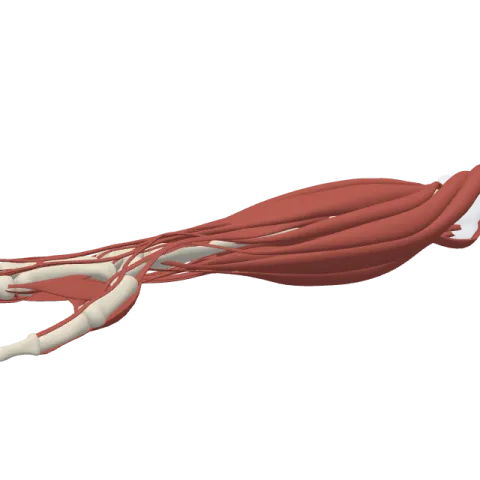
The palmar interossei are three small muscles that lie between the metacarpals on the palm side of the hand. They pull the index, ring and little fingers toward the middle finger (adduction) and are supplied by the deep branch of the ulnar nerve.
Where it is
The spaces between the five metacarpals are filled by the interosseous muscles (inter = between, os = bone). There are two sets: the dorsal interossei, closer to the back of the hand, and the palmar interossei, closer to the palm. You cannot see the palmar ones from the surface; they lie under the flexor tendons and the lumbricals.
Most textbooks count three palmar interossei:
- the first lies on the second metacarpal and moves the index finger;
- the second lies on the fourth metacarpal and moves the ring finger;
- the third lies on the fifth metacarpal and moves the little finger.
The middle finger has none, because adduction is measured toward the line of the middle finger, so it has nowhere to be adducted to. The thumb is adducted by its own muscle, the adductor pollicis. Some books count four palmar interossei, treating a small slip at the base of the thumb as the first one, so check which convention your course uses.
Origin and insertion
- Origin: each muscle starts on a single bone, the palmar surface of the shaft of the metacarpal of the finger it moves, on the side that faces the middle finger. This gives it a one-sided (unipennate) shape, unlike the dorsal interossei, which start on two neighboring metacarpals.
- Insertion: the base of the proximal phalanx of the same finger and its extensor expansion, again on the side facing the middle finger (see the phalanges of the hand).
So the first palmar interosseous runs along the ulnar side of the index finger, and the second and third run along the radial side of the ring and little fingers.
What it does
- Adduction of the fingers: at the metacarpophalangeal joints, they pull the index, ring and little fingers toward the middle finger, closing the gaps between them.
- Help with the table-top position: because they pass in front of the metacarpophalangeal joints and join the extensor expansion, they help the lumbricals flex the knuckles and extend the finger joints.
You use them to hold a sheet of paper or a playing card between straight fingers, to keep the fingers together when you swim, or to press the fingers against the sides of a tool. They work in opposition to the dorsal interossei, which spread the fingers apart.
Innervation and blood supply
All three palmar interossei are supplied by the deep branch of the ulnar nerve (C8-T1), which crosses the deep palm and supplies every interosseous muscle of the hand. Their blood comes from the palmar metacarpal arteries, branches of the deep palmar arch.
How to remember it
- PAD and DAB: Palmar ADduct, Dorsal ABduct.
- Three palmar, four dorsal: the middle finger gets two dorsal interossei and no palmar one.
- They face the middle: every palmar interosseous starts and ends on the side of its finger that faces the middle finger.
- The card grip: holding a card between two straight fingers is palmar interossei work.
The bones of the hand page shows the metacarpals they sit between. Test yourself in the forearm and hand quiz.
Frequently asked questions
What do the palmar interossei do?
They adduct the index, ring and little fingers toward the middle finger at the metacarpophalangeal joints. They also help flex these joints and extend the finger joints.
How many palmar interossei are there?
Three in most textbooks, acting on the index, ring and little fingers. Some count a fourth at the thumb.
What nerve supplies the palmar interossei?
The deep branch of the ulnar nerve.
Why does the middle finger have no palmar interosseous?
Finger adduction is defined as movement toward the middle finger, so the middle finger itself is never adducted.
What is the difference between palmar and dorsal interossei?
The palmar interossei bring the fingers together and start on one metacarpal each. The dorsal interossei spread the fingers apart and start on two neighboring metacarpals each.
