
Muscle · Upper limb
Flexor digitorum profundus: origin, insertion, action and innervation
The flexor digitorum profundus runs from the ulna to the distal phalanges of fingers 2-5. It bends the fingertips; ulnar and median nerves supply it.
Quick answer
- Latin name
- Musculus flexor digitorum profundus
- Origin
- Upper three quarters of the anterior and medial surfaces of the ulna, and the adjacent interosseous membrane
- Insertion
- Palmar surface of the bases of the distal phalanges of fingers 2-5 (phalanges of the hand)
- Action
- Flexes the distal interphalangeal joints of fingers 2-5 (the only muscle that can); also flexes the proximal interphalangeal and metacarpophalangeal joints and helps flex the wrist
- Innervation
- Medial part (fingers 4-5): ulnar nerve (C8-T1). Lateral part (fingers 2-3): anterior interosseous nerve, a branch of the median nerve (C8-T1)
- Blood supply
- Muscular branches of the ulnar artery and the anterior interosseous artery
See it on the 3D body
The flexor digitorum profundus lit on the 3D forearm and hand, as in the forearm and hand quiz. Turn the body, peel the layers, tap any structure for its name.
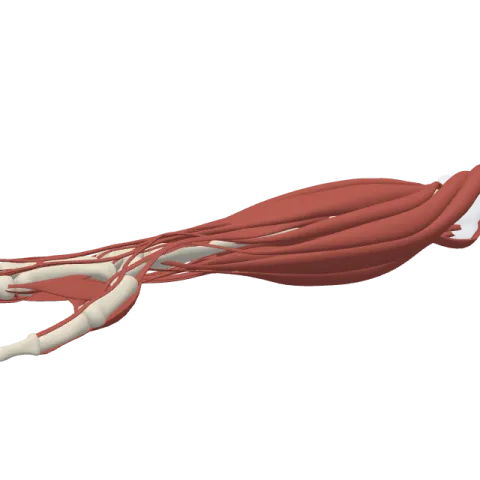
The flexor digitorum profundus (FDP) is the deep finger flexor of the forearm: it starts on the ulna and sends four tendons to the tips of the index, middle, ring and little fingers. It is the only muscle that can bend the last joint of these fingers, and it has two nerves: the ulnar nerve for the ring and little fingers, the anterior interosseous nerve for the index and middle fingers.
Where it is
The FDP lies in the deep layer of the anterior forearm, directly on the front of the ulna and the interosseous membrane. The flexor digitorum superficialis covers it, and the flexor pollicis longus lies next to it on the radius side. Near the wrist, the small square pronator quadratus sits underneath its tendons. Profundus is Latin for "deep", the opposite of superficialis.
Above the wrist the muscle divides into four tendons. They pass through the carpal tunnel, behind the superficialis tendons, and spread out across the palm. In the palm, the four small lumbricals take their origin from these tendons. In each finger, the FDP tendon shares a fibrous sheath with the superficialis tendon, then passes through a split in it to reach the fingertip.
The part that goes to the index finger usually has a fairly separate belly, while the parts for the middle, ring and little fingers stay joined together. This is why the index fingertip bends on its own more easily than the others.
Origin and insertion
- Origin: the upper three quarters of the anterior and medial surfaces of the ulna, and the neighboring part of the interosseous membrane that joins the ulna to the radius.
- Insertion: the palmar surface of the bases of the distal phalanges of fingers 2 to 5 (see the phalanges of the hand).
What it does
- Bends the fingertips: it flexes the distal interphalangeal (DIP) joints of the four fingers. No other muscle flexes these joints.
- Bends the rest of the finger: once the tip is bent, its pull carries on to the proximal interphalangeal and metacarpophalangeal joints, which closes the hand into a full fist.
- Helps flex the wrist: its tendons cross the front of the wrist, so it assists the wrist flexors.
Try it: hold the middle joint of one finger straight with the other hand and bend only the tip. That movement is pure FDP. "Jersey finger" is the name for an injury in which the FDP tendon pulls away from the base of the distal phalanx, most often in the ring finger.
Innervation and blood supply
The FDP has a split nerve supply:
- the medial part, for the ring and little fingers, is supplied by the ulnar nerve (C8-T1);
- the lateral part, for the index and middle fingers, is supplied by the anterior interosseous nerve, a branch of the median nerve (C8-T1; some books give C7-C8).
The lumbricals that grow out of its tendons follow a similar split: the median nerve supplies the two on the index side and the ulnar nerve the two on the little-finger side.
Its blood comes from muscular branches of the ulnar artery and from the anterior interosseous artery, which runs down the front of the interosseous membrane with the nerve of the same name.
How to remember it
- Profundus goes the farthest: the deepest tendon travels the longest distance, all the way to the distal phalanx.
- It threads the needle: in each finger the superficialis tendon opens like the eye of a needle and the profundus tendon goes through it.
- Half and half: the FDP is shared between two nerves. The ring and little finger half belongs to the ulnar nerve, the same nerve that supplies the skin of the little finger and half of the ring finger.
See all three layers of the anterior compartment on muscles of the forearm, then test yourself in the forearm and hand quiz.
Frequently asked questions
What is the action of the flexor digitorum profundus?
It flexes the distal interphalangeal joints of fingers 2 to 5, and it is the only muscle that can. It also helps flex the other finger joints and the wrist.
Which nerve supplies the flexor digitorum profundus?
Two nerves. The ulnar nerve supplies the part for the ring and little fingers, and the anterior interosseous nerve (from the median nerve) supplies the part for the index and middle fingers.
What is the difference between the flexor digitorum profundus and superficialis?
The profundus lies deeper, starts on the ulna and inserts on the distal phalanges, so it bends the fingertips. The superficialis lies on top of it, inserts on the middle phalanges and bends the middle joints.
Does the flexor digitorum profundus move the thumb?
No. It only reaches fingers 2 to 5. The tip of the thumb is bent by the flexor pollicis longus.
