Muscle · Trunk
Semispinalis cervicis: origin, insertion, action and innervation
The semispinalis cervicis runs from T1-T6 transverse processes to the C2-C5 spines. It extends the neck and is supplied by cervical posterior rami.
Quick answer
- Latin name
- Musculus semispinalis cervicis
- Origin
- Transverse processes of the upper five or six thoracic vertebrae (T1–T6)
- Insertion
- Spinous processes of the cervical vertebrae C2–C5, mostly the axis
- Action
- Both sides: extend the cervical spine. One side: turns the neck toward the opposite side
- Innervation
- Medial branches of the posterior (dorsal) rami of the cervical spinal nerves
- Blood supply
- Deep cervical artery, vertebral artery and dorsal branches of the upper posterior intercostal arteries
See it on the 3D body
The semispinalis cervicis lit on the 3D back, as in the back quiz. Turn the body, peel the layers, tap any structure for its name.
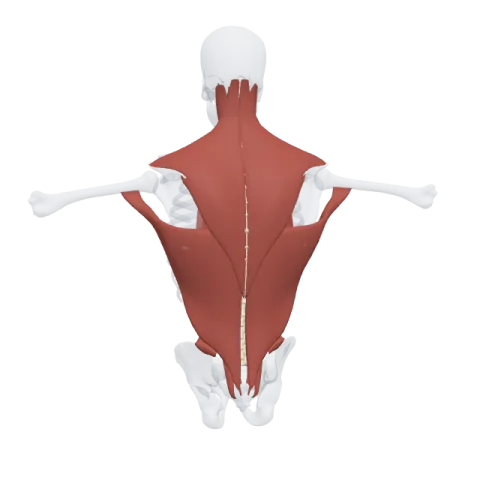
The semispinalis cervicis is a deep muscle of the back of the neck that runs from the upper thoracic transverse processes to the spinous processes of the upper cervical vertebrae, especially the axis. It extends the cervical spine when both sides contract.
Where it is
The semispinalis cervicis lies directly under the semispinalis capitis and on top of the multifidus, in the deep layer of the back of the neck. It is the middle of the three semispinalis parts: thoracis below, cervicis in the neck, capitis above.
All three belong to the transversospinal muscles, which run from the transverse process of one vertebra upward and inward to the spinous process of a vertebra several levels higher. The semispinalis fibers are the longest of the group, crossing four to six vertebrae.
Its upper end has a well-known attachment: the large, forked spinous process of the axis (C2). Two suboccipital muscles, the rectus capitis posterior major and the obliquus capitis inferior, start from the same spinous process, so the axis acts as an anchor point where these deep neck muscles meet.
Origin and insertion
- Origin: the transverse processes of the upper five or six thoracic vertebrae.
- Insertion: the spinous processes of the cervical vertebrae from C2 to C5. The largest slip goes to the axis.
So the muscle runs upward and toward the midline, like a series of diagonal cables pulling the cervical spinous processes down and back.
What it does
- Extends the cervical spine: both sides together pull the cervical spinous processes down toward the thoracic spine, straightening the neck from a bent-forward position and holding it up.
- Turns the neck to the opposite side: one side alone rotates the cervical vertebrae so the face turns away from the working muscle. This follows from the direction of its fibers, which run from a lateral point below to a medial point above.
It also helps hold the cervical spine steady while the more superficial muscles move the head.
Innervation and blood supply
The semispinalis cervicis is supplied by the medial branches of the posterior (dorsal) rami of the cervical spinal nerves. This is the usual pattern for the transversospinal muscles, while the erector spinae columns are described as taking the lateral branches.
Its blood comes from the deep cervical artery, the vertebral artery and the dorsal branches of the upper posterior intercostal arteries.
How to remember it
- T to C, transverse to spinous: starts on thoracic transverse processes, ends on cervical spinous processes.
- Axis anchor: the strongest slip ends on C2, the vertebra with the biggest spinous process in the upper neck.
- The sandwich filling: semispinalis capitis on top, multifidus underneath, semispinalis cervicis in between.
- Medial branch muscle: transversospinal muscles take medial branches; erector spinae muscles take lateral branches.
Compare the spinous processes of C2 and C7 on the bones of the spine page. Test yourself in the back quiz.
Frequently asked questions
What does the semispinalis cervicis do?
Both sides together extend the cervical spine. One side alone turns the neck toward the opposite side.
Where does the semispinalis cervicis insert?
On the spinous processes of C2 to C5, mostly on the axis.
What is the difference between semispinalis capitis and cervicis?
The capitis is superficial and ends on the occipital bone. The cervicis lies under it and ends on the cervical spinous processes.
What group does the semispinalis cervicis belong to?
The transversospinal muscles, with the multifidus and the rotatores.
