
Muscle · Trunk
Semispinalis capitis: origin, insertion, action and innervation
The semispinalis capitis runs from C4-T6 to the occipital bone. It extends the head and upper neck and is supplied by cervical posterior rami.
Quick answer
- Latin name
- Musculus semispinalis capitis
- Origin
- Transverse processes of the upper six or seven thoracic vertebrae and C7, and the articular processes of C4–C6 (cervical vertebrae)
- Insertion
- Occipital bone, between the superior and inferior nuchal lines (skull)
- Action
- Both sides: extend the head at the atlanto-occipital joint and extend the upper cervical spine. One side: tilts the head to the same side
- Innervation
- Medial branches of the posterior (dorsal) rami of the cervical spinal nerves; the greater occipital nerve (C2) pierces it
- Blood supply
- Occipital artery, deep cervical artery and branches of the vertebral artery
See it on the 3D body
The semispinalis capitis lit on the 3D back, as in the back quiz. Turn the body, peel the layers, tap any structure for its name.
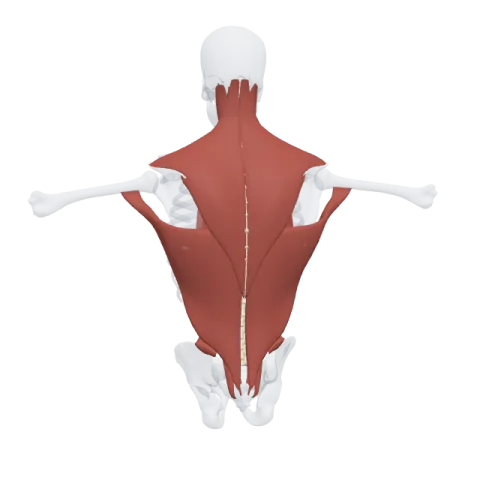
The semispinalis capitis is a broad, thick muscle at the back of the neck that runs from the upper thoracic and lower cervical vertebrae to the back of the skull. Acting on both sides, it is the main muscle that tips the head back.
Where it is
The semispinalis capitis lies on either side of the midline at the back of the neck, under the trapezius and the splenius capitis. The two muscles form the vertical bulges you feel on either side of the shallow groove at the back of the neck, the nuchal groove.
It belongs to the transversospinal group, the deep back muscles that run from transverse processes up toward the midline. The group has three layers: the semispinalis on the surface, the multifidus under it and the small rotatores deepest. The semispinalis itself has three parts, named by where they end: thoracis, cervicis and capitis. The capitis part is the largest.
Deep to it lies the semispinalis cervicis, and higher up, the small suboccipital muscles that work on the atlas and the axis.
A key landmark: the greater occipital nerve, from C2, comes up from below and pierces the semispinalis capitis on its way to the skin of the back of the scalp.
Origin and insertion
- Origin: the tips of the transverse processes of the upper six or seven thoracic vertebrae and C7, and the articular processes of C4 to C6.
- Insertion: the occipital bone of the skull, on the broad area between the superior and inferior nuchal lines, close to the midline.
Its medial part is often crossed by a band of tendon, which divides it into two bellies, one above the other.
What it does
- Extends the head: both sides together tip the head back at the atlanto-occipital joint, the joint between the skull and the atlas. This is its main action.
- Extends the upper neck: it also straightens the upper cervical spine, pulling the head and neck back as a unit.
- Tilts the head: one side alone bends the head toward that side.
It works all day without you noticing: because the head's weight sits in front of the spine, the semispinalis capitis helps keep it from dropping forward.
Innervation and blood supply
The semispinalis capitis is supplied by the medial branches of the posterior (dorsal) rami of the cervical spinal nerves. The greater occipital nerve, the medial branch of the posterior ramus of C2, gives it branches as it passes through.
Its blood comes from the occipital artery, the deep cervical artery and muscular branches of the vertebral artery.
How to remember it
- Capitis means of the head: caput is Latin for head, and this is the only part of the semispinalis that reaches the skull.
- Rope behind the neck: press both thumbs on either side of the nuchal groove and tip your head back. The ropes that tighten are the semispinalis capitis.
- The nerve goes through it: the greater occipital nerve pierces this muscle, a favorite exam question.
- Capitis is the big one: of the three semispinalis parts, the one on the head is the largest.
Test yourself in the back quiz.
Frequently asked questions
What does the semispinalis capitis do?
Both sides together extend the head and the upper cervical spine. One side tilts the head to that side.
Where does the semispinalis capitis insert?
On the occipital bone, between the superior and inferior nuchal lines.
Which nerve pierces the semispinalis capitis?
The greater occipital nerve, from the posterior ramus of C2.
Is the semispinalis capitis part of the erector spinae?
No. It belongs to the transversospinal group, which lies deep to the erector spinae.
