
Muscle · Trunk
Spinalis muscle: origin, insertion, action and innervation
The spinalis links spinous processes, from the T11-L2 region to the upper thoracic spines and C2. It extends the spine and is supplied by posterior rami.
Quick answer
- Latin name
- Musculus spinalis
- Origin
- Spinous processes of the upper lumbar and lower thoracic vertebrae (about T11–L2); in the neck, the ligamentum nuchae and the spinous process of C7
- Insertion
- Spinous processes of the upper thoracic vertebrae; in the neck, the spinous process of the axis (C2)
- Action
- Both sides: extend the vertebral column. One side: weakly bends it to the same side
- Innervation
- Posterior (dorsal) rami of the spinal nerves
- Blood supply
- Posterior intercostal and lumbar arteries; deep cervical artery in the neck
See it on the 3D body
The spinalis lit on the 3D back, as in the back quiz. Turn the body, peel the layers, tap any structure for its name.
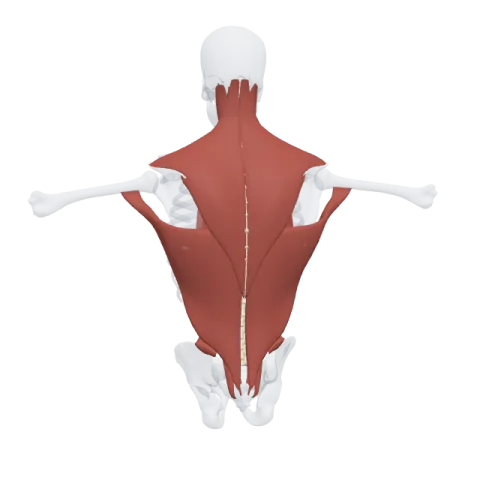
The spinalis is the smallest and most medial column of the erector spinae. It runs from spinous process to spinous process along the middle of the back and extends the vertebral column when both sides contract.
Where it is
The spinalis lies right against the spinous processes, the bony bumps you feel down the middle of your back. It is the inner column of the erector spinae, with the longissimus just lateral to it and the iliocostalis farther out.
It is mostly a thoracic muscle. In many people it is thin and blends with the longissimus beside it, so in a dissection it can look like the inner edge of that larger muscle rather than a separate column. Deep to it lie the transversospinal muscles: the semispinalis, which continues up the neck as the semispinalis cervicis, and the multifidus.
Origin and insertion
Anatomists describe up to three parts:
- Spinalis thoracis, the main and most constant part: from the spinous processes of the upper lumbar vertebrae and the lower thoracic vertebrae, about T11 to L2, to the spinous processes of the upper thoracic vertebrae, roughly T1 to T8.
- Spinalis cervicis: from the lower part of the ligamentum nuchae and the spinous process of C7 to the spinous process of the axis, C2. It is often small or missing.
- Spinalis capitis: when present, it is usually fused with the semispinalis capitis and is rarely studied on its own.
Because each fiber skips several vertebrae, the spinalis thoracis spans most of the thoracic spine with only a few slips.
What it does
- Extends the vertebral column: both sides together pull the spinous processes closer, straightening the back from a bent position and holding it upright.
- Bends to the side, weakly: one side alone can tilt the spine toward that side, but it is so close to the midline that its leverage for this movement is poor.
Its job is mainly postural, adding to the steady pull of the larger erector spinae columns.
Innervation and blood supply
The spinalis, like the other erector spinae columns, is supplied by the posterior (dorsal) rami of the spinal nerves. Some textbooks name their lateral branches, as for the rest of the erector spinae; others give only the posterior rami. Each level takes its own segmental nerve.
Blood comes from the dorsal branches of the posterior intercostal and lumbar arteries in the trunk, and from the deep cervical artery in the neck.
How to remember it
- Spine to spine: the spinalis connects spinous processes to spinous processes. Nothing else.
- Its name says where it lives: of the three erector spinae columns, the spinalis is the one that hugs the spine, and it is also the thinnest.
- Skip the rope: picture each fiber jumping over several spinous processes before landing.
- Mostly thoracis: if an exam only asks about one part, it is the spinalis thoracis.
Count the thoracic vertebrae it spans on the bones of the spine page. Test yourself in the back quiz.
Frequently asked questions
What does the spinalis muscle do?
Both sides together extend the vertebral column. One side alone can weakly bend it to that side.
Where is the spinalis muscle?
Along the middle of the back, right against the spinous processes, mostly in the thoracic region.
Is the spinalis part of the erector spinae?
Yes. It is the medial column, with the longissimus and the iliocostalis lateral to it.
What nerve supplies the spinalis?
Branches of the posterior rami of the spinal nerves, one for each level.
