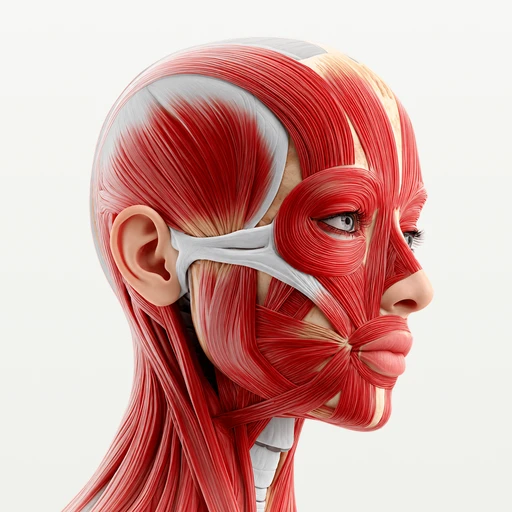
See it on the 3D body
The tongue lit on the 3D head, as in the head quiz. Turn the body, peel the layers, tap any structure for its name.
Quick answer
- Latin name
- Lingua
- System
- Digestive system
- Location
- Floor of the mouth, with its root extending back into the oropharynx, attached to the mandible, hyoid bone and skull
- Function
- Moves food during chewing, pushes it back for swallowing, carries taste buds and shapes the sounds of speech
The tongue is a muscular organ in the floor of the mouth, made almost entirely of skeletal muscle covered by a mucous membrane. It moves food onto the teeth, pushes it back for swallowing, carries most of the taste buds and shapes the sounds of speech.
Where it is
The tongue fills the floor of the mouth, inside the curve of the lower teeth. Its front part is free and very mobile. Its back part, the root, goes down and back into the throat, toward the epiglottis of the larynx.
It is anchored to bone through its muscles: to the inside of the mandible in front, to the hyoid bone below, and to the styloid process of the skull and the soft palate above and behind. Underneath, a fold of mucous membrane, the lingual frenulum, ties its tip to the floor of the mouth.
Parts
A V-shaped groove on the upper surface, the terminal sulcus, divides the tongue into two parts. A small pit at the point of the V, the foramen cecum, marks where the thyroid gland began to form in the embryo.
- The oral part, in front of the groove, makes up about two-thirds of the tongue. It has a tip, a top surface (the dorsum) and an underside.
- The pharyngeal part, behind the groove, faces the throat. Its surface is bumpy because of the lingual tonsil, a patch of lymphatic tissue.
Papillae
The top and sides of the oral part are covered with small projections called papillae:
- Filiform papillae: thin and pointed, the most numerous. They have no taste buds but make the surface rough, which helps grip food.
- Fungiform papillae: mushroom-shaped, scattered among the filiform ones, mostly at the tip and sides. They carry taste buds.
- Vallate papillae: a row of large, round papillae just in front of the terminal sulcus, each surrounded by a trench. They carry many taste buds.
- Foliate papillae: small folds on the back of the sides, with taste buds.
Muscles
- Intrinsic muscles lie entirely inside the tongue: the superior and inferior longitudinal, the transverse and the vertical muscles. They change its shape: shorter, narrower, flatter or curled.
- Extrinsic muscles start on bone outside the tongue and change its position. The genioglossus from the mandible pushes the tongue forward and out. The hyoglossus from the hyoid bone pulls it down. The styloglossus from the styloid process pulls it up and back. The palatoglossus from the soft palate lifts its back part.
What it does
- Chewing. The tongue pushes food between the teeth and mixes it with saliva.
- Swallowing. It shapes the chewed food into a ball, the bolus, then presses up against the palate and pushes it back into the pharynx. The esophagus then carries it to the stomach.
- Taste. Taste buds in the papillae detect sweet, salty, sour, bitter and umami.
- Speech. Rapid changes in shape and position, against the teeth and the palate, form many consonants and vowels.
Nerves and blood supply
The tongue has several nerves, a favorite exam topic:
- Movement: the hypoglossal nerve (cranial nerve XII) supplies all the tongue muscles except the palatoglossus, which is supplied by the vagus nerve.
- Touch, front two-thirds: the lingual nerve, a branch of the trigeminal nerve.
- Taste, front two-thirds: the chorda tympani, a branch of the facial nerve that travels with the lingual nerve.
- Touch and taste, back third: the glossopharyngeal nerve (cranial nerve IX).
Blood comes from the lingual artery, a branch of the external carotid artery.
How to study it
- Shape inside, position outside. Intrinsic muscles change shape; extrinsic muscles move the whole tongue.
- "Glossus" means tongue. Each extrinsic muscle is named after its bony anchor plus "glossus": genio (chin), hyo (hyoid), stylo (styloid), palato (palate).
- The palatoglossus exception. Every tongue muscle uses nerve XII except the palatoglossus.
In Anatomy Atlas 3D, the tongue is part of the stomach and intestines set of the organ explorer, at the start of the digestive tract. You can also tap it in the full body, then cut the body with a sagittal cross section to see its full length from tip to root. Quiz yourself in the head quiz. The app is free on iPad and iPhone.
Frequently asked questions
What is the tongue made of?
Mostly skeletal muscle, in bundles running in three directions, covered by a mucous membrane with papillae.
Which nerve moves the tongue?
The hypoglossal nerve (cranial nerve XII), for all tongue muscles except the palatoglossus.
Which papillae have no taste buds?
The filiform papillae. They are the most numerous and give the tongue its rough texture.
Are the taste areas of the tongue really separate?
No. The old "tongue map" with one taste per zone is wrong: all five basic tastes can be detected wherever there are taste buds.
