
Muscle · Trunk
Splenius capitis: origin, insertion, action and innervation
The splenius capitis runs from the ligamentum nuchae and C7-T3 to the mastoid process. It extends the head and neck, supplied by cervical posterior rami.
Quick answer
- Latin name
- Musculus splenius capitis
- Origin
- Lower half of the ligamentum nuchae and the spinous processes of C7 and the upper three or four thoracic vertebrae
- Insertion
- Mastoid process of the temporal bone and the lateral third of the superior nuchal line of the occipital bone (skull)
- Action
- Both sides: extend the head and neck. One side: bends the neck to the same side and turns the face to the same side
- Innervation
- Lateral branches of the posterior (dorsal) rami of the middle cervical spinal nerves
- Blood supply
- Muscular branches of the occipital artery, with help from the transverse cervical artery
See it on the 3D body
The splenius capitis lit on the 3D back, as in the back quiz. Turn the body, peel the layers, tap any structure for its name.
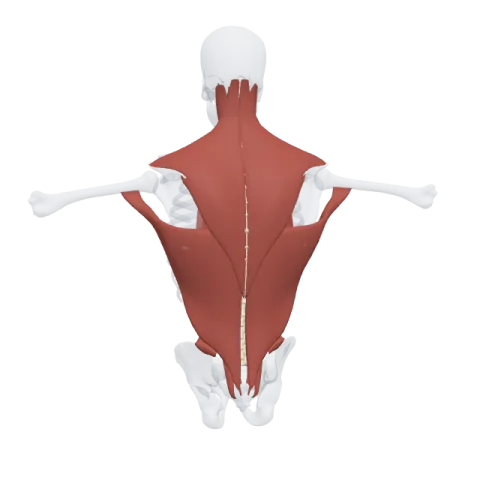
The splenius capitis is a broad, flat muscle at the back of the neck that runs from the midline of the lower neck and upper back up and out to the mastoid process behind the ear. Both sides together extend the head and neck; one side alone turns the face toward that side.
Where it is
The splenius capitis lies under the trapezius and the sternocleidomastoid, and on top of the deeper neck muscles such as the semispinalis capitis and the longissimus capitis. Its fibers run upward and outward, at an angle, like a strap wrapped around the deep muscles.
A small part of it is not covered by other muscles: it shows in the floor of the posterior triangle of the neck, the space between the back edge of the sternocleidomastoid and the front edge of the trapezius.
Just below it, and continuous with it, lies its smaller partner, the splenius cervicis. The two together are called the splenius muscles, the most superficial layer of the deep (intrinsic) back muscles.
Origin and insertion
- Origin: the lower half of the ligamentum nuchae, the strong midline ligament at the back of the neck, and the spinous processes of C7 and the upper three or four thoracic vertebrae.
- Insertion: the mastoid process of the temporal bone and the lateral third of the superior nuchal line of the occipital bone, both on the skull. This insertion lies just under the attachment of the sternocleidomastoid.
What it does
- Extends the head and neck: both sides together pull the head and the upper neck backward, as when you look up at the ceiling.
- Turns the face to the same side: one side alone rotates the head so the face turns toward the working muscle. It does this together with the sternocleidomastoid of the opposite side.
- Bends the neck to the side: one side also tilts the head and neck toward the same shoulder.
At rest, the splenius muscles help the deeper extensors keep the head balanced on top of the spine.
Innervation and blood supply
The splenius capitis is supplied by the lateral branches of the posterior (dorsal) rami of the middle cervical spinal nerves. This places it firmly among the deep back muscles, which all take posterior rami, unlike the trapezius above it, which is supplied by the accessory nerve.
Its blood comes mainly from muscular branches of the occipital artery, which runs across its upper part, with help from the transverse cervical artery lower down.
How to remember it
- Splenius means bandage: from the Greek splenion. The muscle wraps around the deeper neck muscles like a bandage.
- "Same-side turner": splenius capitis turns the face to its own side; the sternocleidomastoid turns it to the opposite side. Turning your head left uses your left splenius capitis and your right sternocleidomastoid.
- Capitis goes to the head: splenius capitis ends on the skull, splenius cervicis ends on the cervical vertebrae.
- Hidden under two famous muscles: trapezius behind, sternocleidomastoid on the side, splenius capitis peeking out between them in the posterior triangle.
Test yourself in the back quiz.
Frequently asked questions
What does the splenius capitis do?
Both sides extend the head and neck. One side bends the neck to that side and turns the face toward the same side.
Where does the splenius capitis insert?
On the mastoid process of the temporal bone and the lateral third of the superior nuchal line of the occipital bone.
What nerve supplies the splenius capitis?
The lateral branches of the posterior rami of the middle cervical spinal nerves.
What is the difference between splenius capitis and splenius cervicis?
The splenius capitis starts higher and ends on the skull. The splenius cervicis starts lower, on the thoracic spinous processes, and ends on the transverse processes of the upper cervical vertebrae.
