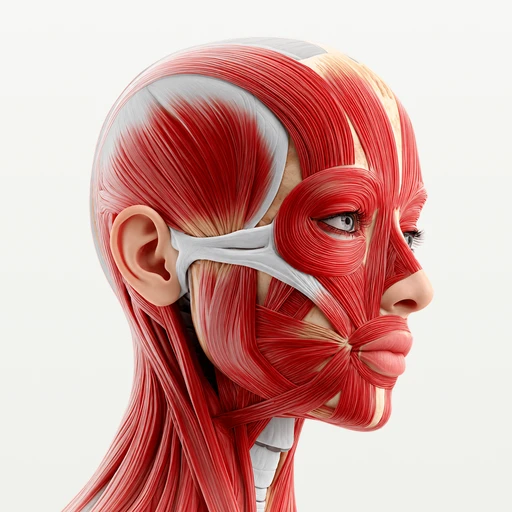
Muscle · Trunk
Splenius cervicis: origin, insertion, action and innervation
The splenius cervicis runs from the T3-T6 spines to the transverse processes of C1-C3. It extends and turns the neck, supplied by cervical posterior rami.
Quick answer
- Latin name
- Musculus splenius cervicis
- Origin
- Spinous processes of the third to sixth thoracic vertebrae (T3–T6)
- Insertion
- Posterior tubercles of the transverse processes of the upper two or three cervical vertebrae: the atlas, the axis and often C3
- Action
- Both sides: extend the neck. One side: bends the neck laterally and turns it to the same side
- Innervation
- Lateral branches of the posterior (dorsal) rami of the middle and lower cervical spinal nerves
- Blood supply
- Branches of the occipital and transverse cervical arteries, with the deep cervical artery
See it on the 3D body
The splenius cervicis lit on the 3D back, as in the back quiz. Turn the body, peel the layers, tap any structure for its name.
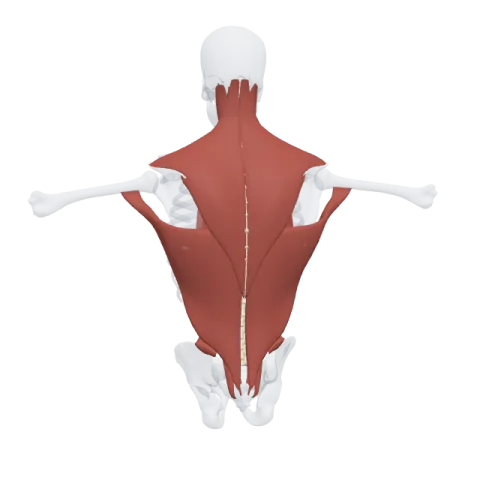
The splenius cervicis is a narrow, flat muscle at the back of the upper trunk and neck that runs from the upper thoracic spinous processes to the transverse processes of the atlas, the axis and often C3. Both sides together extend the neck, and one side alone bends and turns the neck toward its own side.
Where it is
The splenius cervicis is the lower and smaller of the two splenius muscles. It starts below the splenius capitis and runs along its outer edge, so the two look like one sheet that splits as it climbs: the capitis part heads for the skull, the cervicis part curves forward to the side of the upper neck.
It lies deep to the trapezius, the rhomboids and the serratus posterior superior, and superficial to the erector spinae, in particular the longissimus. Near its upper end it passes close to the levator scapulae, which also starts from the transverse processes of the upper cervical vertebrae.
Origin and insertion
- Origin: the spinous processes of the thoracic vertebrae T3 to T6.
- Insertion: the posterior tubercles of the transverse processes of the upper cervical vertebrae: the atlas (C1), the axis (C2) and often C3.
So it runs from the midline of the upper back, upward and outward, to the side of the upper neck. This diagonal line explains its turning action.
What it does
- Extends the neck: both sides together pull the cervical spine backward, straightening it or bending it back.
- Turns the neck to the same side: one side alone pulls the transverse processes of the upper vertebrae backward and inward, rotating the neck so the face turns toward the working muscle.
- Bends the neck to the side: pulling on the upper transverse processes from below, one side draws the top of the neck down toward its own side.
Because it pulls on the atlas and axis, it acts close to the atlanto-axial joint, where a large share of the neck's rotation happens.
Innervation and blood supply
The splenius cervicis is supplied by the lateral branches of the posterior (dorsal) rami of the middle and lower cervical spinal nerves. Like its partner the splenius capitis, it is a true deep back muscle, supplied by posterior rami rather than by the accessory nerve or the brachial plexus.
Its blood comes from branches of the occipital and transverse cervical arteries, with the deep cervical artery supplying its deeper surface.
How to remember it
- Cervicis stops at the neck: the splenius cervicis never reaches the skull. It ends on the transverse processes of C1 to C3.
- Lower start, higher reach: its origin (T3 to T6) is lower than the splenius capitis origin, yet it ends on the very top of the spine.
- Turn toward me: like the splenius capitis, it turns the neck to its own side.
- Spinous to transverse: it goes from spinous processes to transverse processes, the opposite direction to the semispinalis, which goes from transverse to spinous.
Find the transverse processes of the atlas and axis on the bones of the spine page. Test yourself in the back quiz.
Frequently asked questions
What does the splenius cervicis do?
Both sides extend the neck. One side bends the neck to that side and turns it toward the same side.
Where does the splenius cervicis attach?
From the spinous processes of T3 to T6 to the transverse processes of the atlas, the axis and often C3.
What nerve supplies the splenius cervicis?
The lateral branches of the posterior rami of the middle and lower cervical spinal nerves.
Is the splenius cervicis a superficial or deep back muscle?
It is the most superficial layer of the deep (intrinsic) back muscles, lying under the trapezius and the rhomboids.
