
Joint · Upper limb
Shoulder joint anatomy: bones, ligaments, rotator cuff and muscles
The shoulder joint is a ball and socket between the humerus and the scapula. Learn its four joints, labrum, ligaments, rotator cuff and muscles that move it.
The shoulder joint, or glenohumeral joint, is the synovial ball and socket joint where the head of the humerus meets the glenoid cavity of the scapula. It moves more freely than any other joint in the body, and it pays for that with stability: the socket is small and shallow, so the four rotator cuff muscles, more than its ligaments, keep the humerus in place.
Which bones form the shoulder joint?
Two bones meet at the shoulder joint itself, and a third holds the scapula to the trunk:
- The humerus, whose large, smooth head faces the body. Next to it sit the greater tubercle on the outer side and the lesser tubercle in front, with the intertubercular groove between them.
- The scapula, whose glenoid cavity on its outer angle is the socket. OpenStax puts its size at about one third of the humeral head. Above the joint, the acromion and the coracoid process stick out from the scapula.
- The clavicle, which does not touch the humerus. It joins the acromion at one end and the sternum at the other, and holds the scapula away from the chest.
A ring of fibrocartilage, the glenoid labrum, runs around the rim of the glenoid cavity and makes the socket a little deeper.
What are the four joints of the shoulder?
When people say "the shoulder" they often mean the whole shoulder girdle. Reaching overhead uses all of it:
| Joint | Between | What it does |
|---|---|---|
| Glenohumeral joint (the shoulder joint) | Head of the humerus and glenoid cavity of the scapula | Ball and socket: moves the arm in every direction |
| Acromioclavicular joint | Acromion of the scapula and lateral end of the clavicle | Small joint at the top of the shoulder |
| Sternoclavicular joint | Medial end of the clavicle and manubrium of the sternum | The only bony link between the upper limb and the trunk |
| Scapulothoracic "joint" | Front of the scapula and the back of the rib cage | No bones touch here: muscles slide the scapula over the chest wall |
The rest of this page is about the glenohumeral joint.
What are the ligaments of the shoulder joint?
The joint capsule runs from the rim of the glenoid cavity to the anatomical neck of the humerus. It is roomy, so the arm can swing far, and on its own it holds the joint only weakly. A few ligaments thicken it or sit above it:
| Ligament | Where it runs | What it does |
|---|---|---|
| Glenohumeral ligaments (superior, middle, inferior) | Three bands in the front wall of the capsule, from the glenoid rim to the humerus | Strengthen the front of the capsule |
| Coracohumeral ligament | From the coracoid process across the top of the joint, splitting into two bands that reach both tubercles | Reinforces the upper capsule and keeps the head from sliding up or down as the arm turns out |
| Transverse humeral ligament | A short bridge over the intertubercular groove | Turns the groove into a tunnel for the long head of the biceps tendon |
| Coracoacromial ligament | Links two parts of the same bone, the coracoid process and the acromion | With them, makes the coracoacromial arch: a roof above the humeral head |
Two more ligaments belong to the acromioclavicular joint rather than the shoulder joint: the weak acromioclavicular ligaments and the strong coracoclavicular ligament, which ties the coracoid process to the underside of the clavicle.
Two fluid-filled sacs let the rotator cuff tendons glide over the scapula. The subacromial bursa sits just under the roof of the acromion, over the supraspinatus tendon; the subscapular bursa lies behind the subscapularis tendon, against the bone.
What holds the shoulder joint together?
Mostly muscle. The four rotator cuff muscles run from the scapula to the tubercles of the humerus, and their tendons blend into the capsule on three sides:
- Supraspinatus, above the spine of the scapula, ends on the top of the greater tubercle.
- Infraspinatus, below the spine, ends on the middle of the greater tubercle.
- Teres minor, along the outer border of the scapula, ends on the lowest part of the greater tubercle.
- Subscapularis, on the front of the scapula, ends on the lesser tubercle.
While the arm moves, these muscles keep pulling the head of the humerus into the glenoid cavity. OpenStax calls them "dynamic ligaments". The underside of the capsule has no rotator cuff tendon over it. The muscles of the shoulder page gives the origin, insertion and action of all 14 shoulder muscles in the app.
Which muscles move the shoulder joint?
The arm moves in six ways at the glenohumeral joint. Most muscles do more than one job:
| Movement | Main muscles | Nerve |
|---|---|---|
| Flexion (arm forward) | Pectoralis major, front fibers of the deltoid, coracobrachialis; the biceps brachii helps | Pectoral nerves, axillary nerve, musculocutaneous nerve |
| Extension (arm back) | Back fibers of the deltoid, latissimus dorsi, teres major; the long head of the triceps brachii helps | Axillary nerve, thoracodorsal nerve, lower subscapular nerve, radial nerve |
| Abduction (arm out to the side) | Supraspinatus starts it, the middle fibers of the deltoid carry it on | Suprascapular nerve, axillary nerve |
| Adduction (arm back to the side) | Latissimus dorsi, pectoralis major, teres major | Thoracodorsal nerve, pectoral nerves, lower subscapular nerve |
| Medial rotation | Subscapularis and teres major, with the pectoralis major, latissimus dorsi and front fibers of the deltoid | Subscapular nerves, pectoral nerves, thoracodorsal nerve, axillary nerve |
| Lateral rotation | Infraspinatus, teres minor | Suprascapular nerve, axillary nerve |
Circling the arm (circumduction) combines these movements. Above shoulder height the humerus cannot go much further on its own: the trapezius and the serratus anterior turn the scapula so that the glenoid cavity faces up, and the arm can reach overhead.
How to study the shoulder joint in 3D
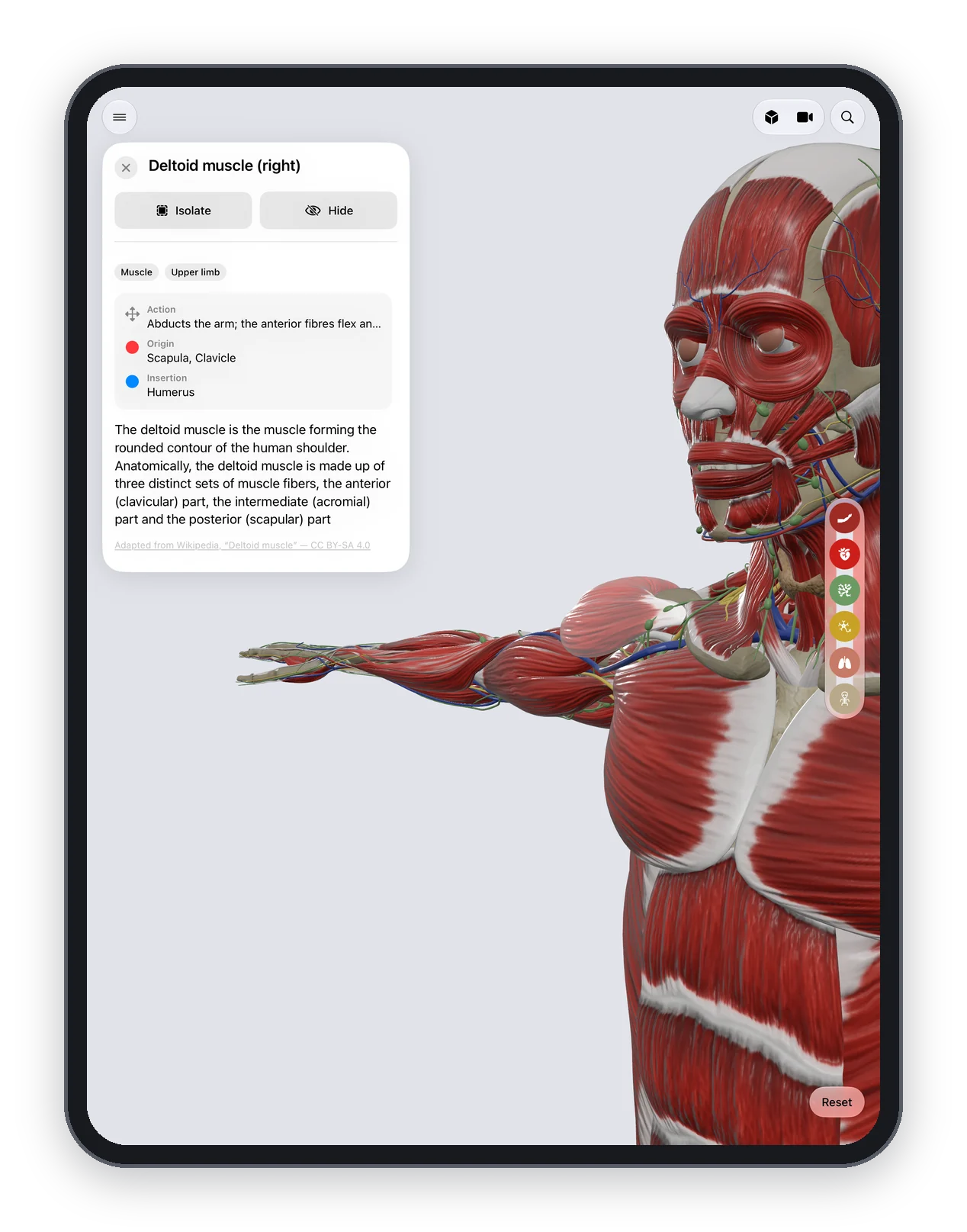
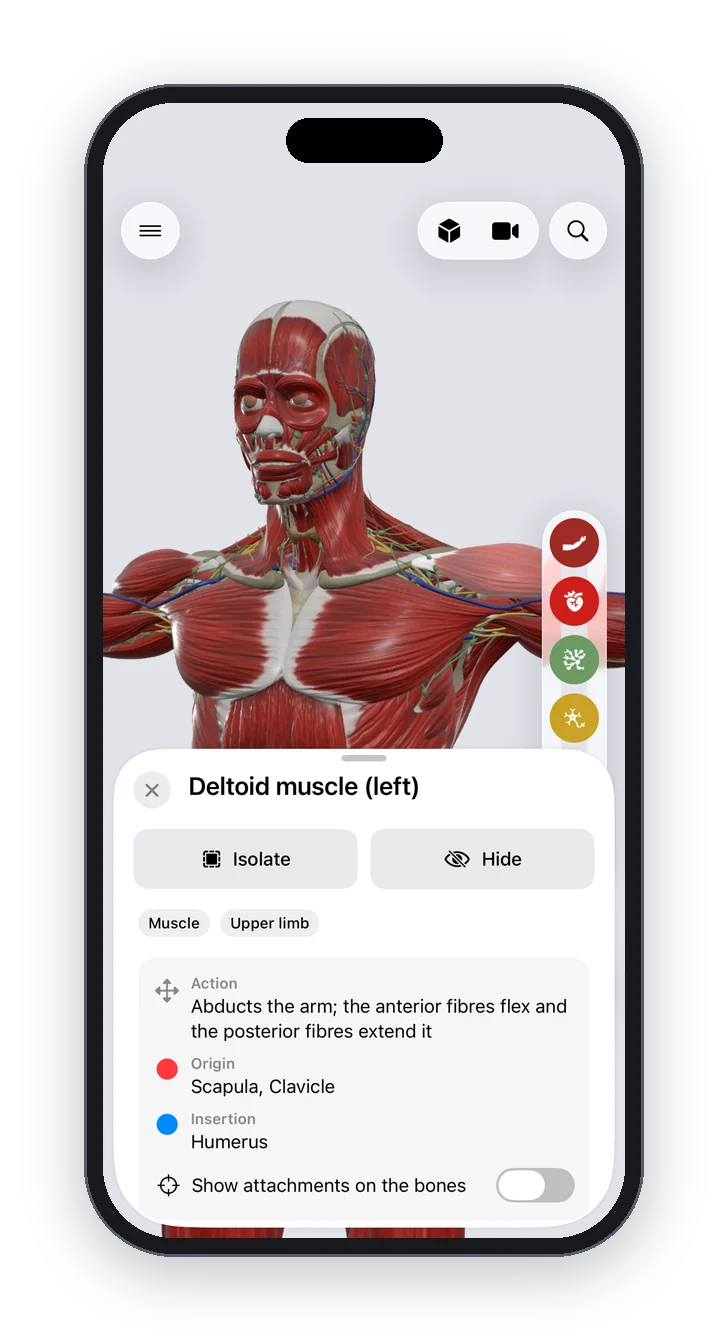
Anatomy Atlas 3D is a free 3D human anatomy atlas for iPad and iPhone: 2,000 structures, no account, no ads, works offline, English and Latin names, and a tap-the-structure quiz. It shows the bones of the shoulder and every muscle in the tables above, but not the labrum, the capsule, the ligaments or the bursae, so use it for the shape of the joint and the muscles that cross it. The landmarks below are parts of the bones, not separate labels:
- Hide the muscles and look at the scapula from the side. Find the glenoid cavity, then the acromion above it and the coracoid process in front.
- Turn to the front of the humerus and find the head, the two tubercles and the groove between them.
- Bring the muscles back and tap the supraspinatus, the infraspinatus, the teres minor and the subscapularis to read where each one ends.
- Test yourself with the shoulder quiz or the upper limb muscles quiz, and find every upper limb page on the upper limb hub.
Further down the arm, the elbow joint works the other way round: a hinge held by bone and ligaments, with far less movement. The hip is the other ball and socket joint of the limbs, with a much deeper socket; the muscles of the hip page covers the muscles that move it.
Frequently asked questions
What type of joint is the shoulder?
The shoulder joint (glenohumeral joint) is a synovial ball and socket joint. It allows flexion, extension, abduction, adduction, medial and lateral rotation, and circumduction.
Which bones make up the shoulder?
The humerus and the scapula form the shoulder joint. The clavicle completes the shoulder girdle: it joins the scapula at the acromioclavicular joint and the sternum at the sternoclavicular joint.
What are the four rotator cuff muscles?
Supraspinatus, infraspinatus, teres minor and subscapularis. The first three end on the greater tubercle of the humerus, the subscapularis on the lesser tubercle. Students often remember them as "SITS".
Why is the shoulder the most mobile joint in the body?
Its socket is small and shallow next to the large head of the humerus, and its capsule is loose. The bones give it little support, so it can move in every direction but relies on muscles to stay in place.
What is the glenoid labrum?
A rim of fibrocartilage around the edge of the glenoid cavity. It makes the shallow socket a little deeper and helps hold the head of the humerus.
Which muscle starts lifting the arm out to the side?
The supraspinatus starts abduction, and the middle fibers of the deltoid take over. Above shoulder height, the trapezius and serratus anterior turn the scapula so the arm can go higher.
Sources
- OpenStax, Anatomy and Physiology 2e, 9.6 Anatomy of selected synovial joints
- OpenStax, Anatomy and Physiology 2e, 8.1 The pectoral girdle
- OpenStax, Anatomy and Physiology 2e, 8.2 Bones of the upper limb
- OpenStax, Anatomy and Physiology 2e, 11.5 Muscles of the pectoral girdle and upper limbs
- TeachMeAnatomy, The Shoulder (Glenohumeral) Joint
- Kenhub, Shoulder joint
- Z-Anatomy, the libre 3D atlas of anatomy
